Carol Yotsudaʻs lively re-cap of the past weekʻs E Kanikapila Kākou concert
E Kanikapila Kākou Week #7 Wrap
featuring
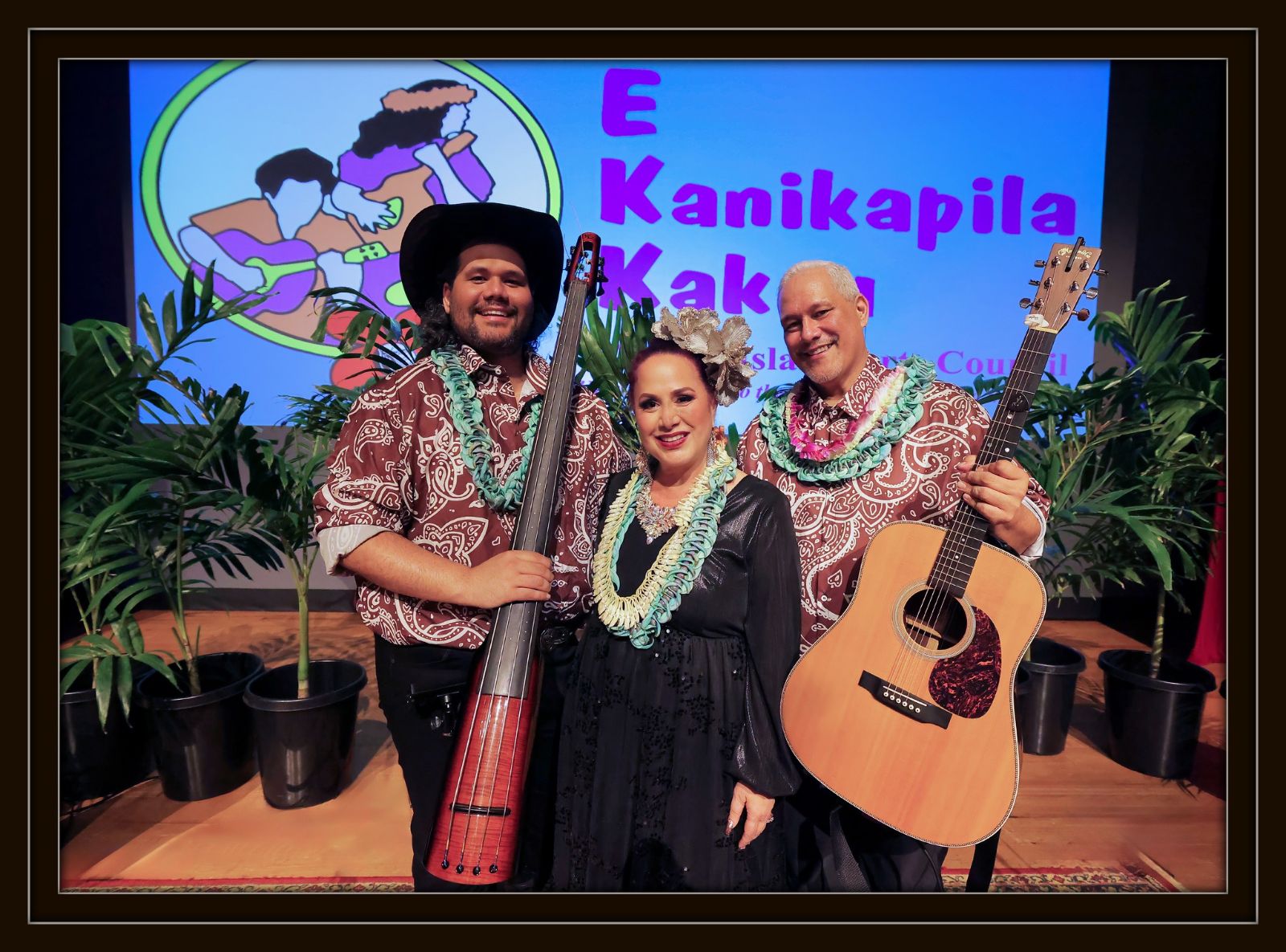
Natalie & Iolani Kamauu & Chaz
“When you see me sing, you’ll hear me dance….”
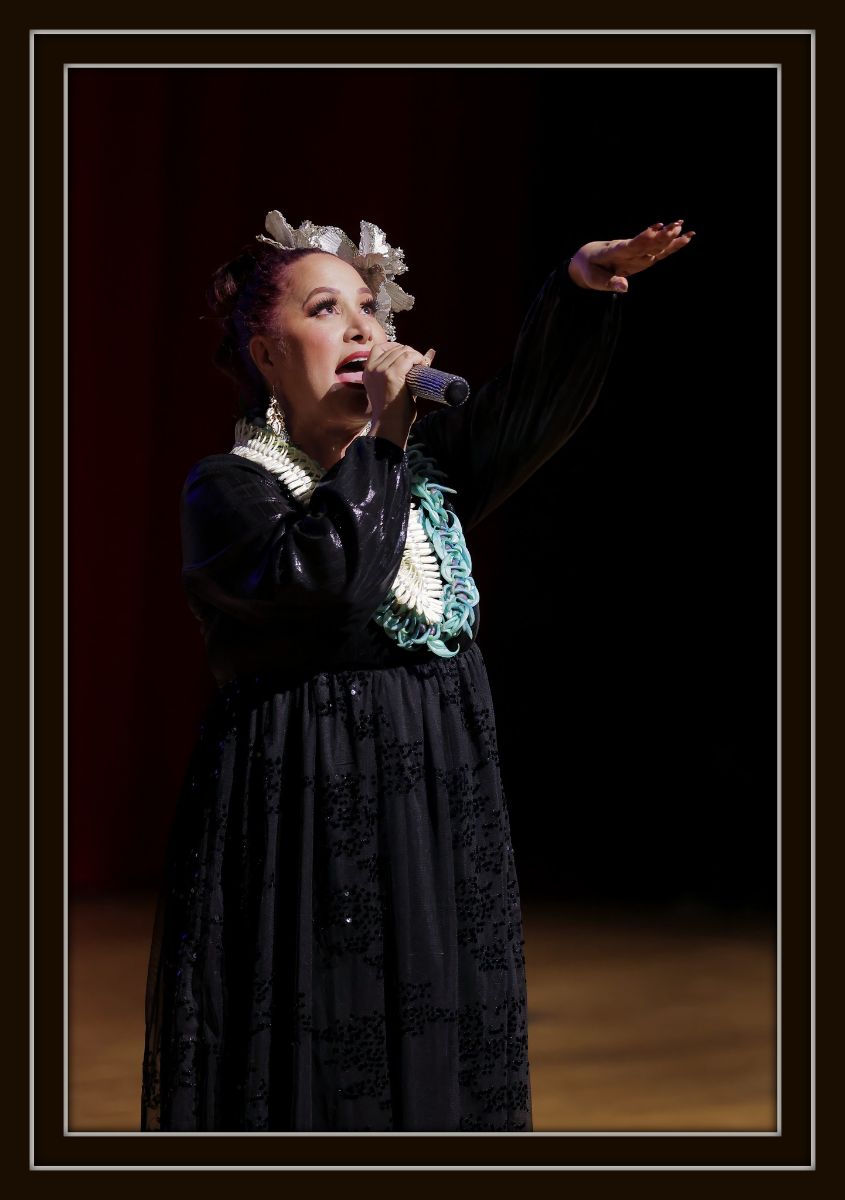
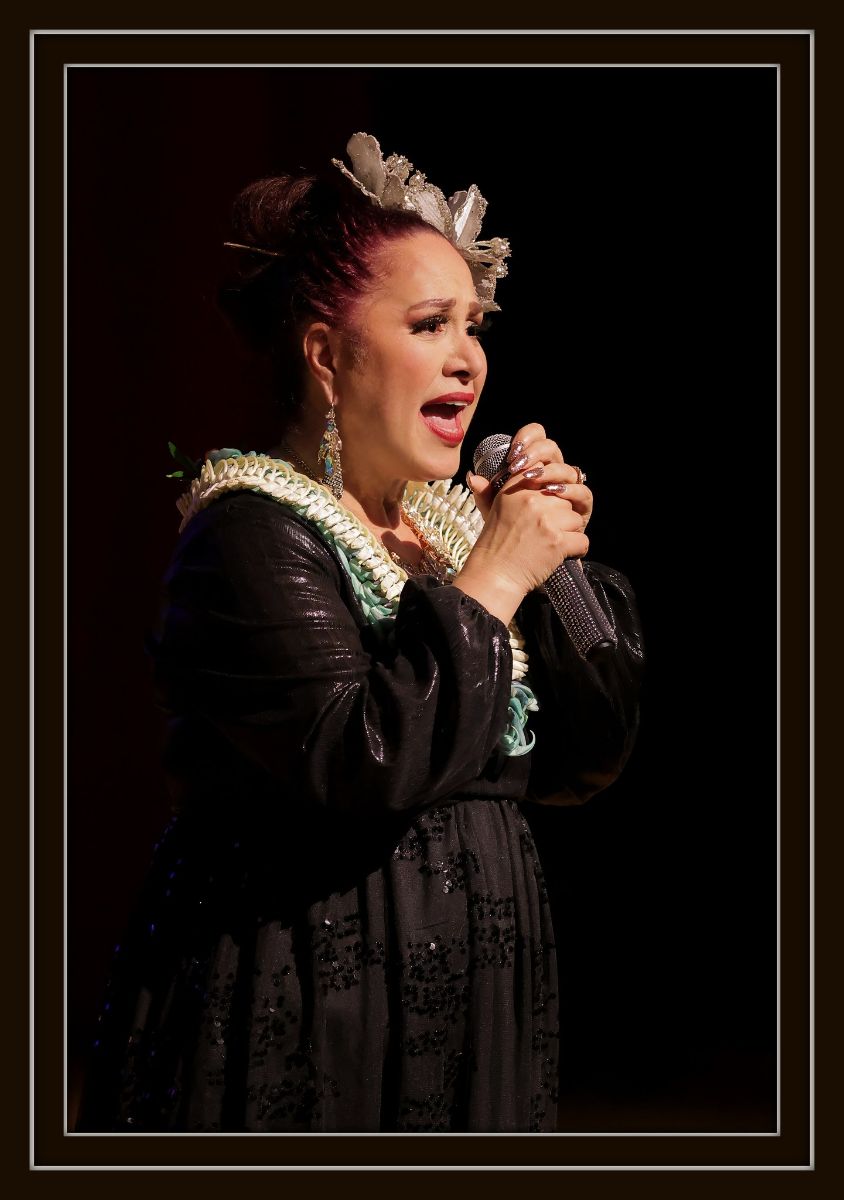
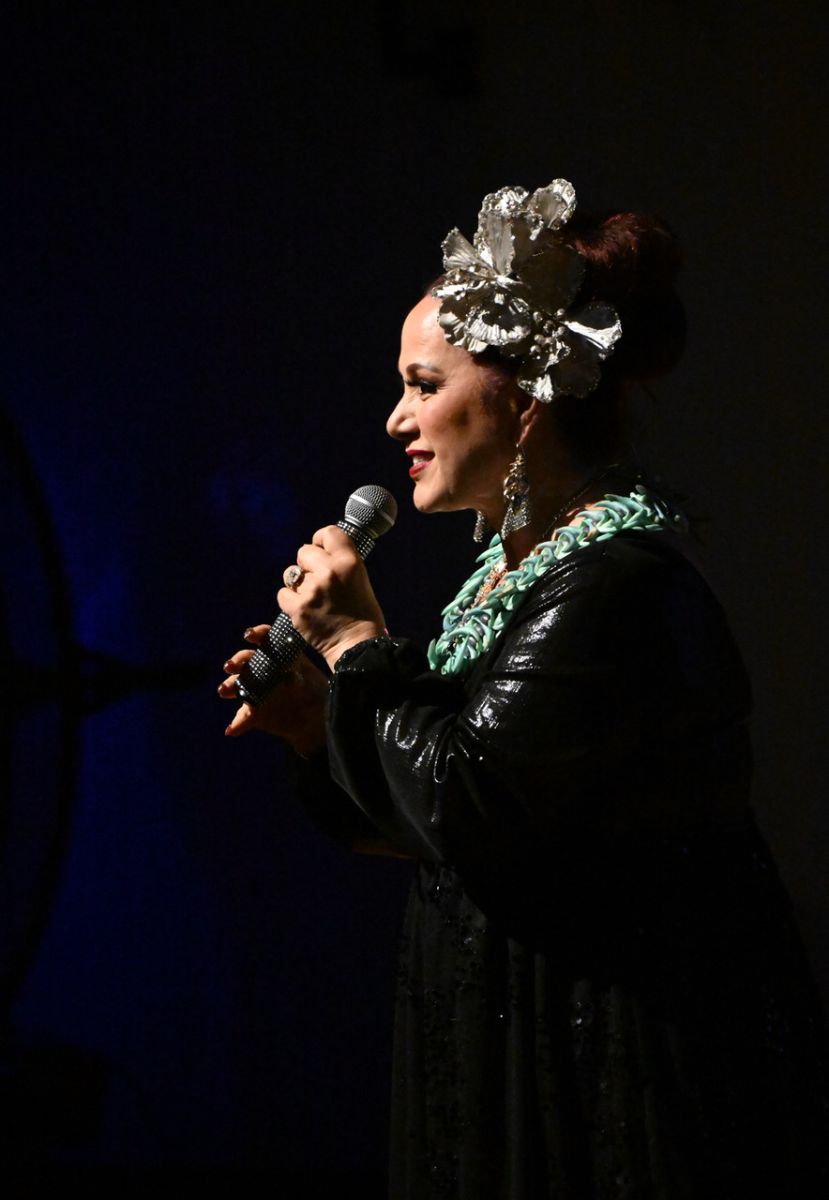
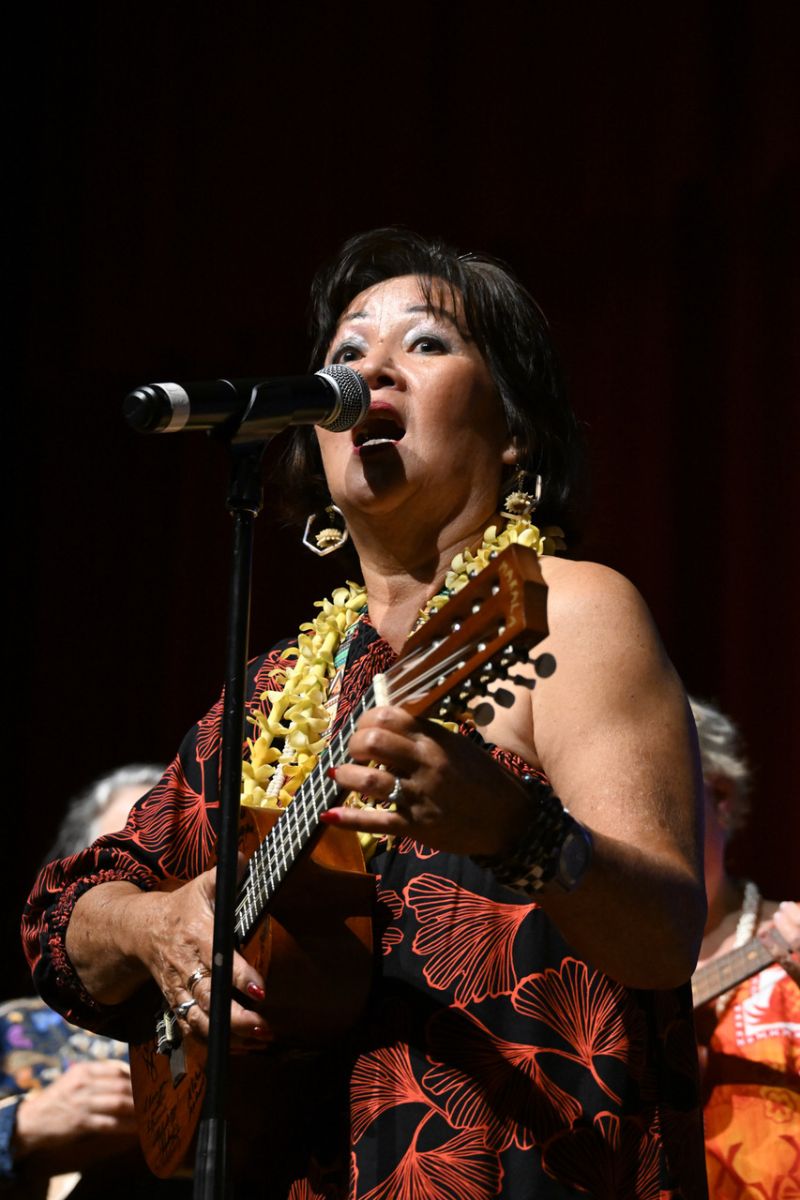
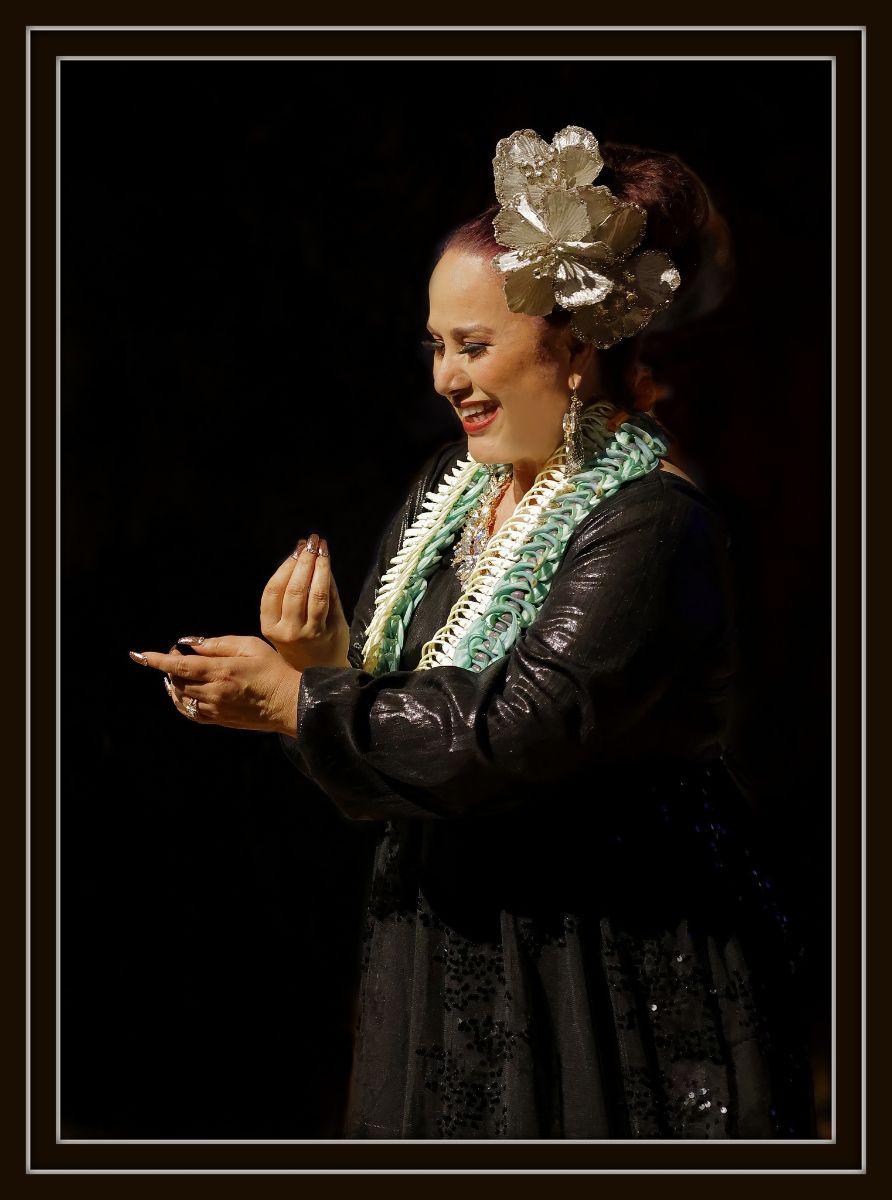
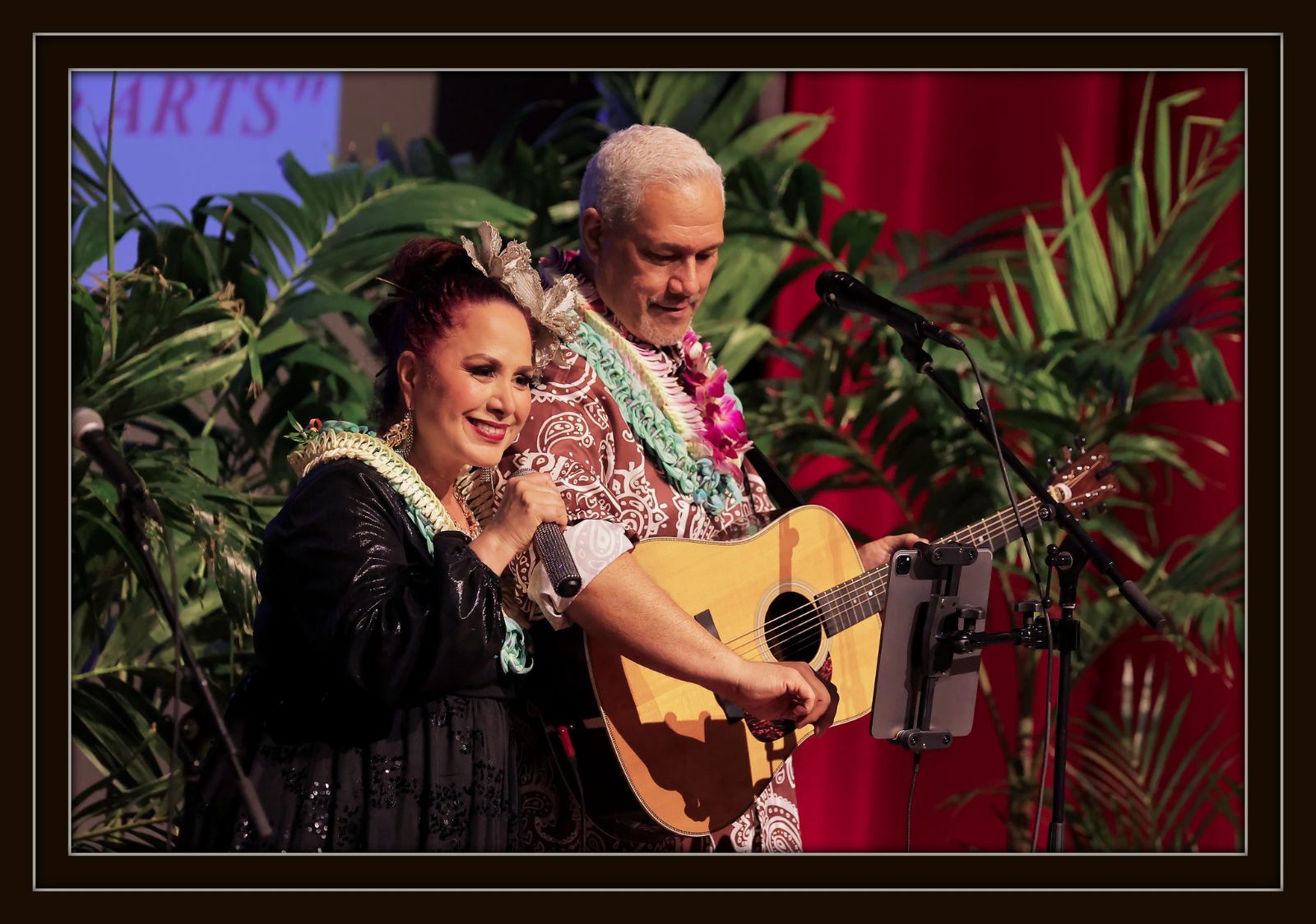
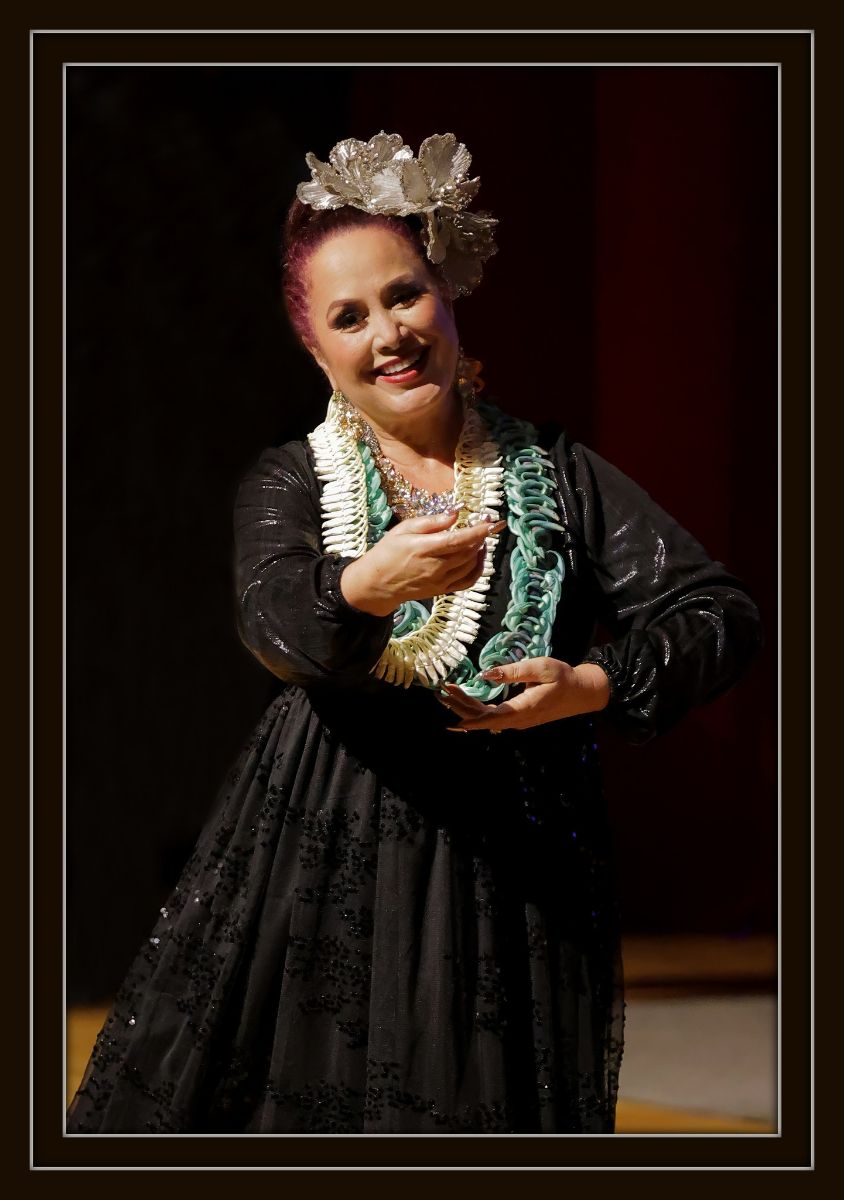
A 10-time Nā Hōkū Hanohano Award winner and 2-time Grammy Award Nominee, together with her husband Iolani, Natalie is an EKK favorite. Always touring Japan and everywhere else, she tries to include an EKK performance whenever she can. A fashionista extraordinaire, Natalie Ai Kamauu sparkles and lights up any stage with her exceptionally powerful vocals, her delightful moʻolelo and her genuine appreciation of her many fans.
. . . and all of that played out beautifully on March 16 when Natalie, Iolani and Chaz finally made it to the KCC PAC stage. It was an unforgettable, emotional performance that delivered the Kanikapila spirit like no other night. The above narrative could not have described it better.
Itʻs so hard to believe that the Kamauu family experienced a major hurdle -- the inter-island airline travel trauma -- just to be here on Kauaʻi for EKK. Their performance gave no hint of what they had to endure all day.
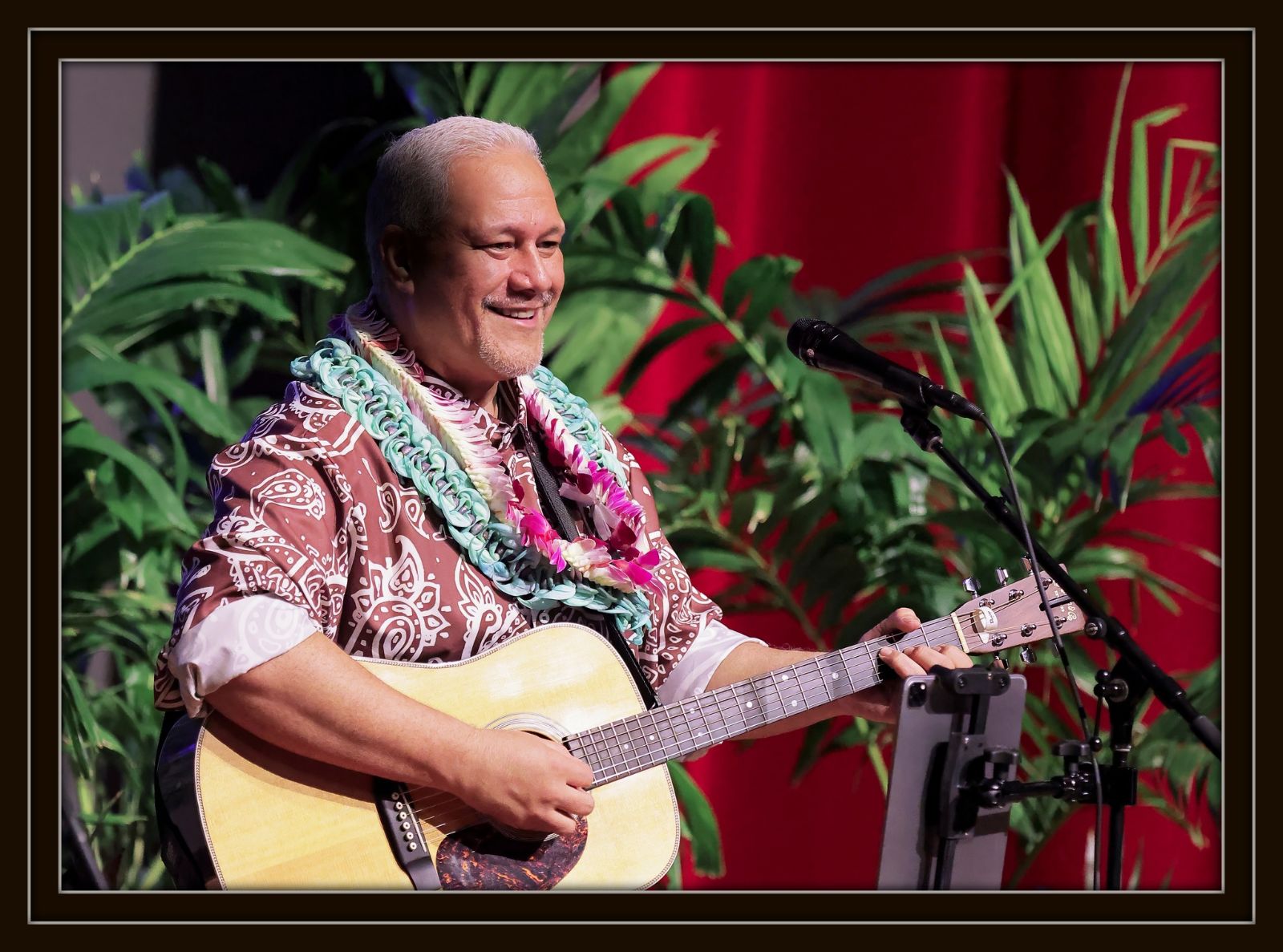
Leaving home in Kamuela on Hawaiʻi island at 6:15 am to catch an 8:30 am flight to Kauaʻi ended up being a nightmare story, what with all the airplane delays, finally leaving Kona at 1:30 pm and arriving at Līhuʻe at 2:30 pm only to find that Iolaniʻs guitar was stuck in Honolulu airport and finally arrived on Kauaʻi in time for the family to reach KCC PAC at 5:00 pm when the guests were entering the theater. Chaz, who arrived at noon from Honolulu, was stuck curbside for hours until his parents arrived. No sound check, no time to relax, they just hit the stage running with their collective years of experience as true troubadours and Ambassadors of Aloha in their top form.
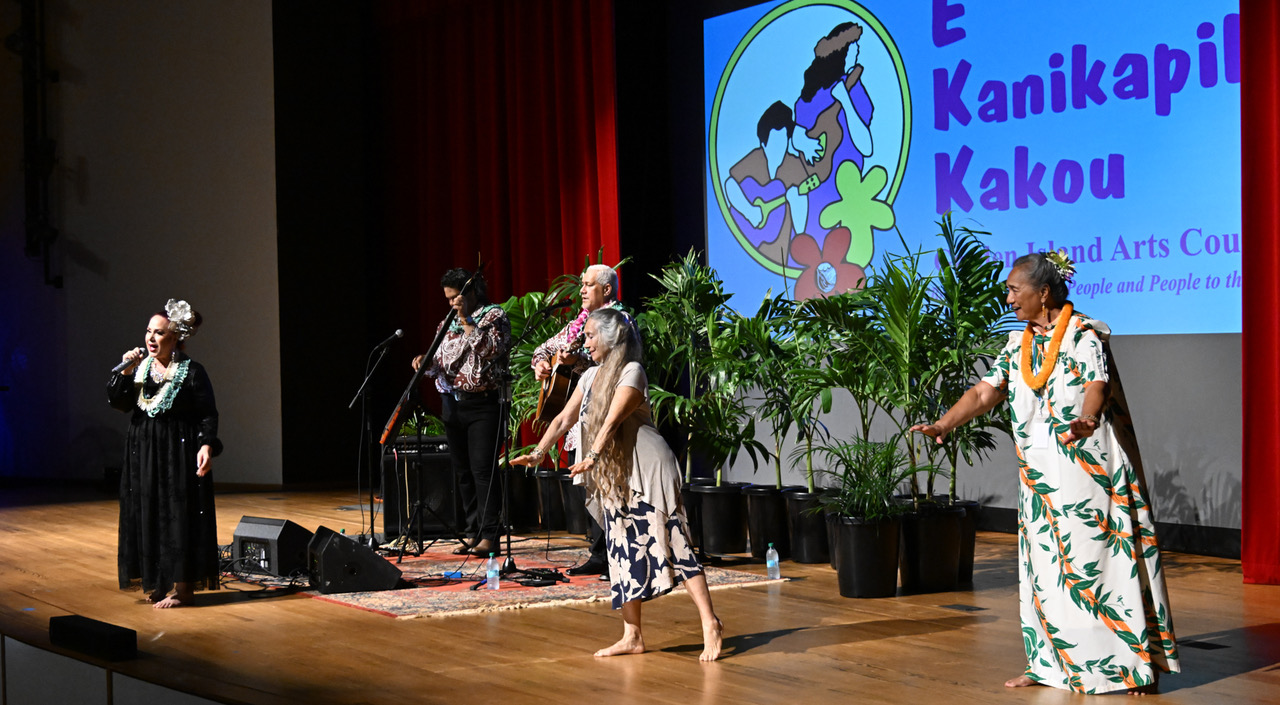
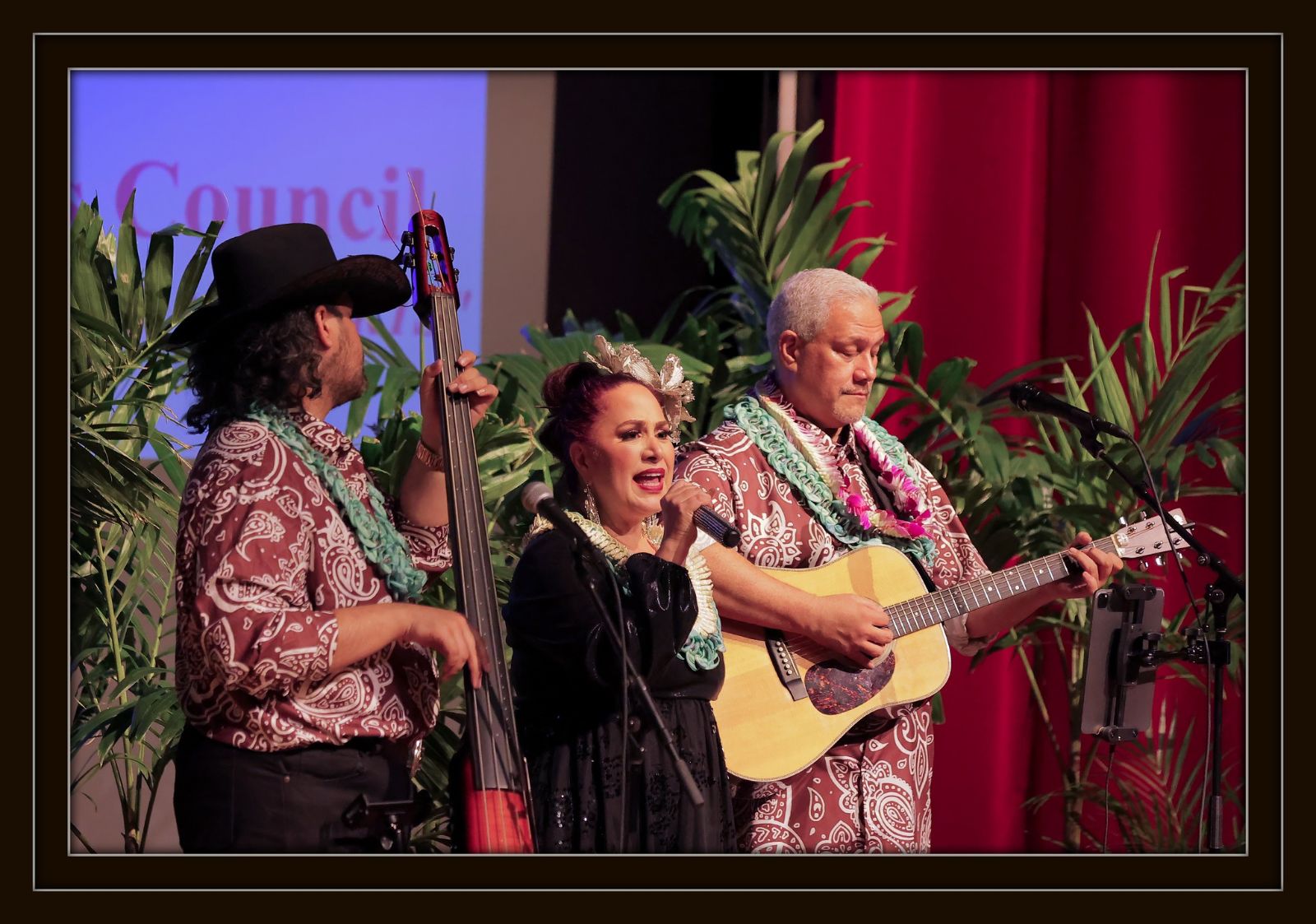
Iolani (husband) and Chaz (son) stepped on stage to begin the musical accompaniment. Her opening number, Make You Feel My Love
, was delivered dramatically with that special Natalie touch . . . an angelic voice ringing out from somewhere off stage and reaching out to the audience as Natalie slowly walks up to the back of the auditorium, down the stairs, along the apron and finally onto the stage. The audience gets a hint of what was to follow.
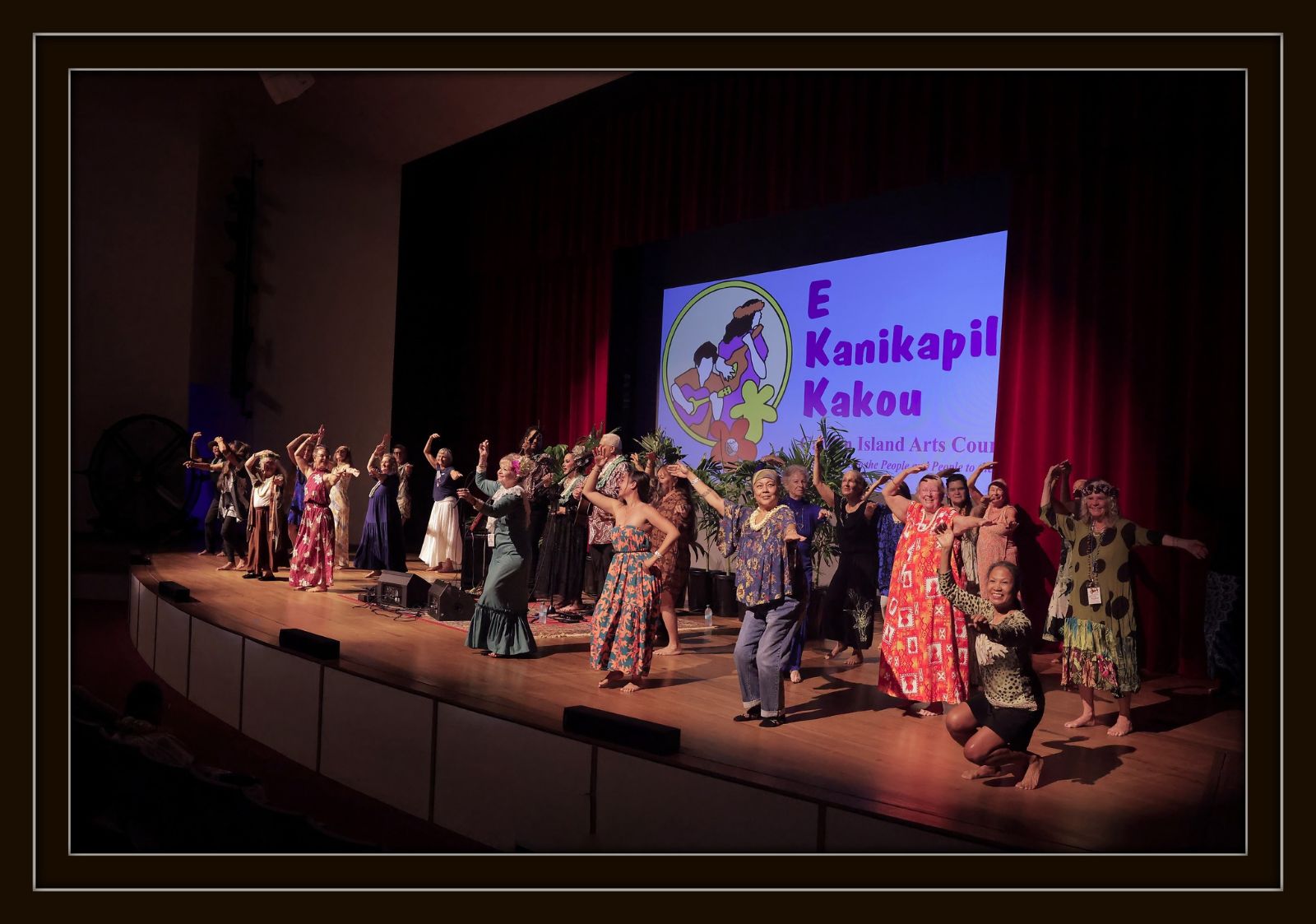
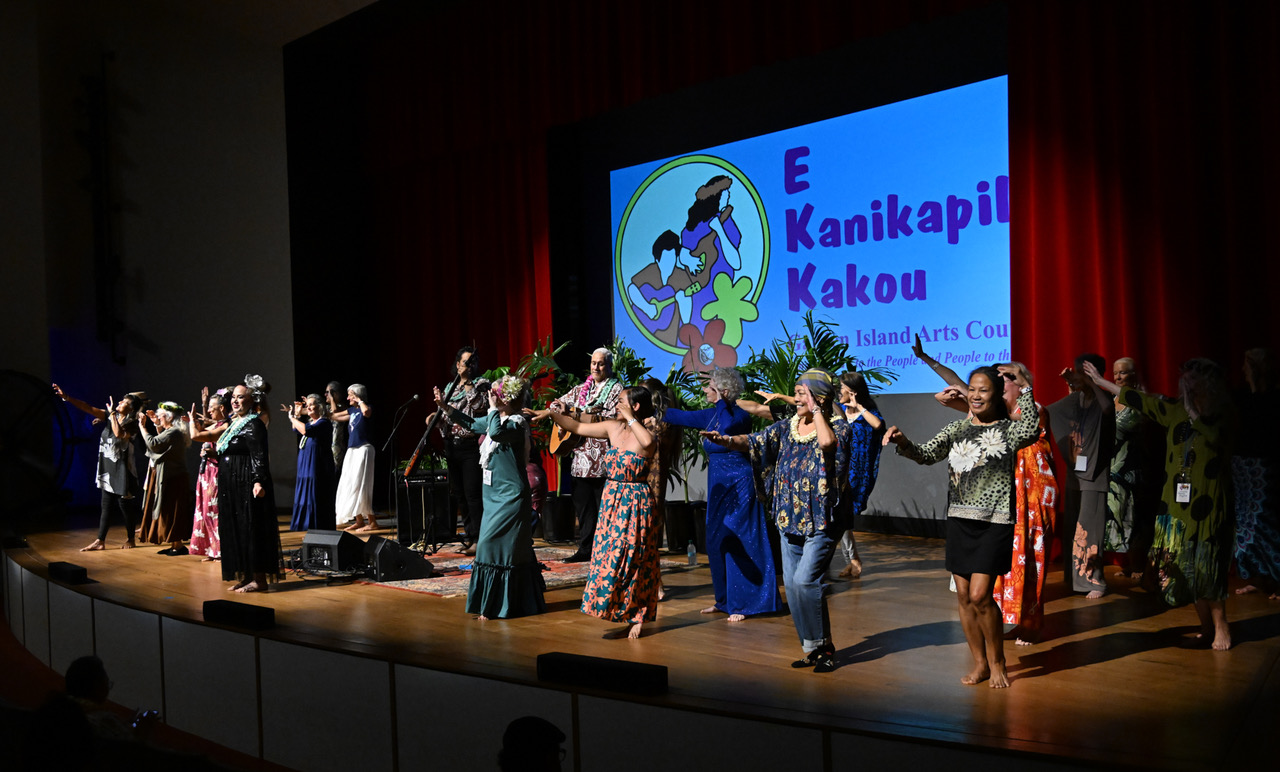
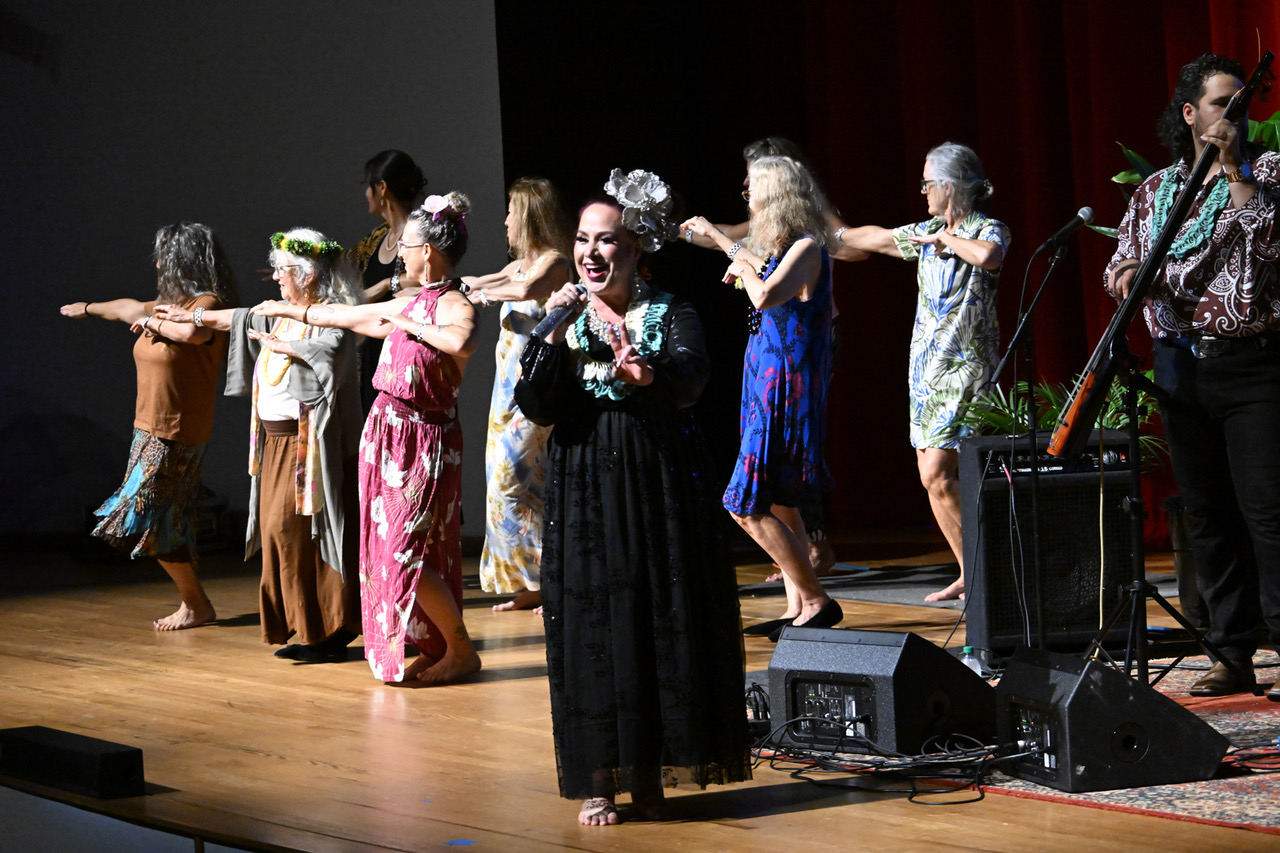
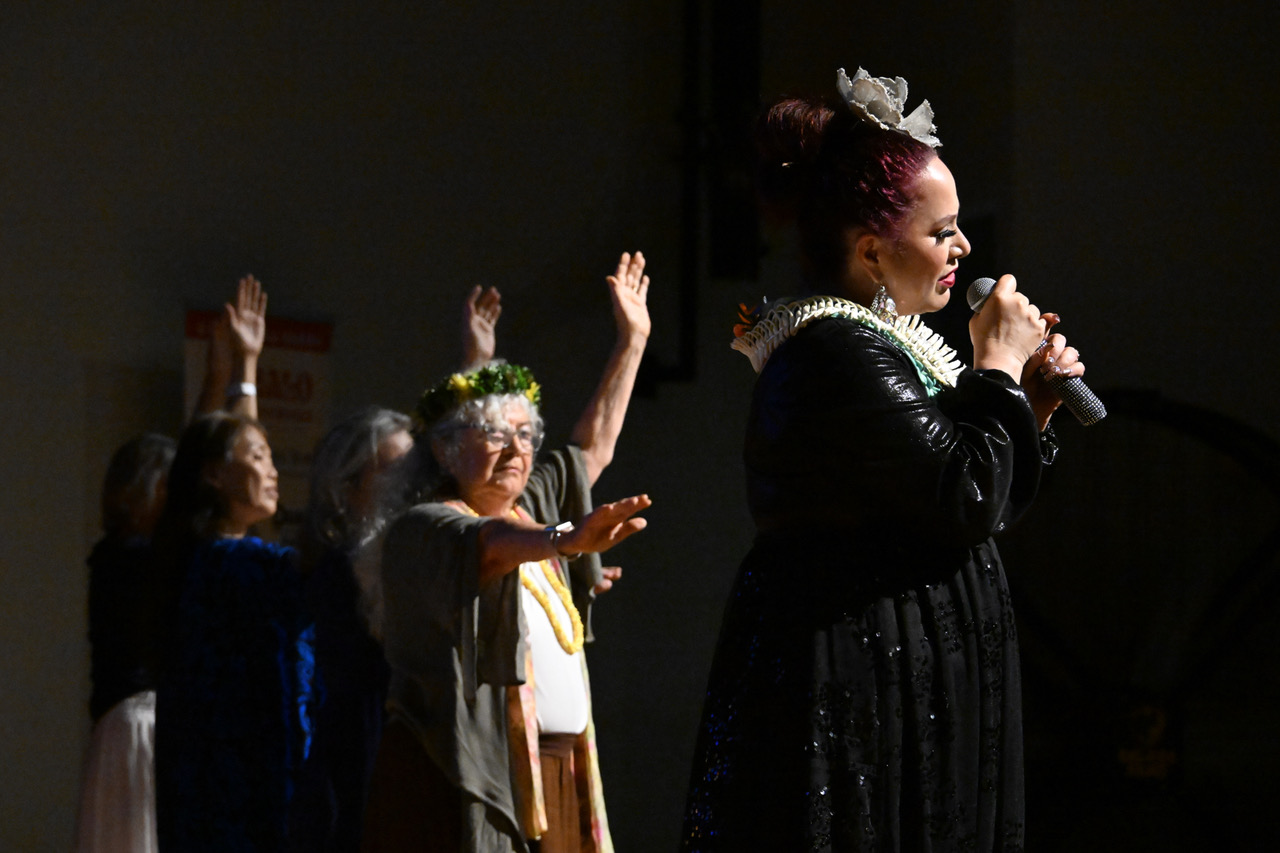
First thing . . . an open invitation to the hula dancers in the audience to join her on stage if they recognize any song and feel moved to do the hula. “Come on up because this is a chance for you, the audience, to have . . . only a moment of enjoyment . . . this is not the Merrie Monarch.”
Natalie and Iolani both come from hula families and were dancing the hula even before they were born, so today they come to Kauaʻi as hula dancers and storytellers and vocalists extraordinaire. It began a long time ago when her mother, Kumu Hula Olana Ai told her to get up and sing because dad, the singer, did not show up and the hula dancers needed the music to dance . . . someone has to sing . . . and thus began the musical journey.
Ke Aloha
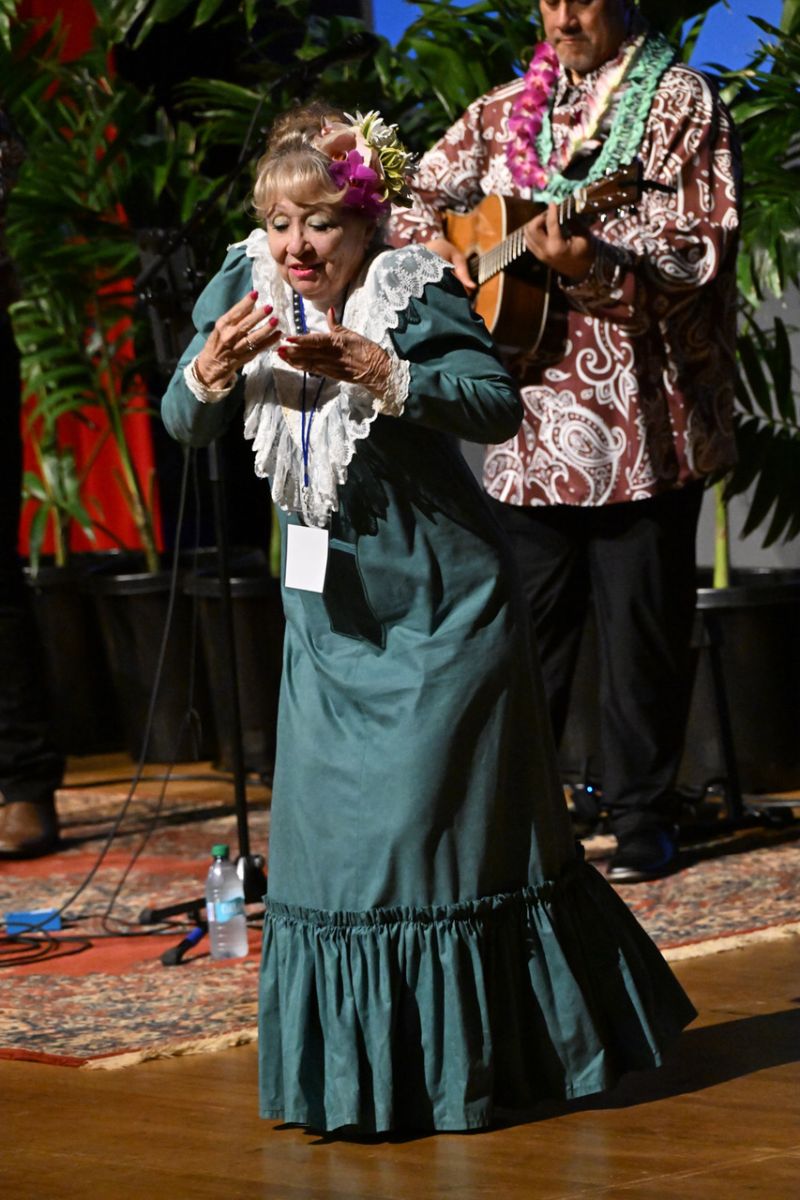
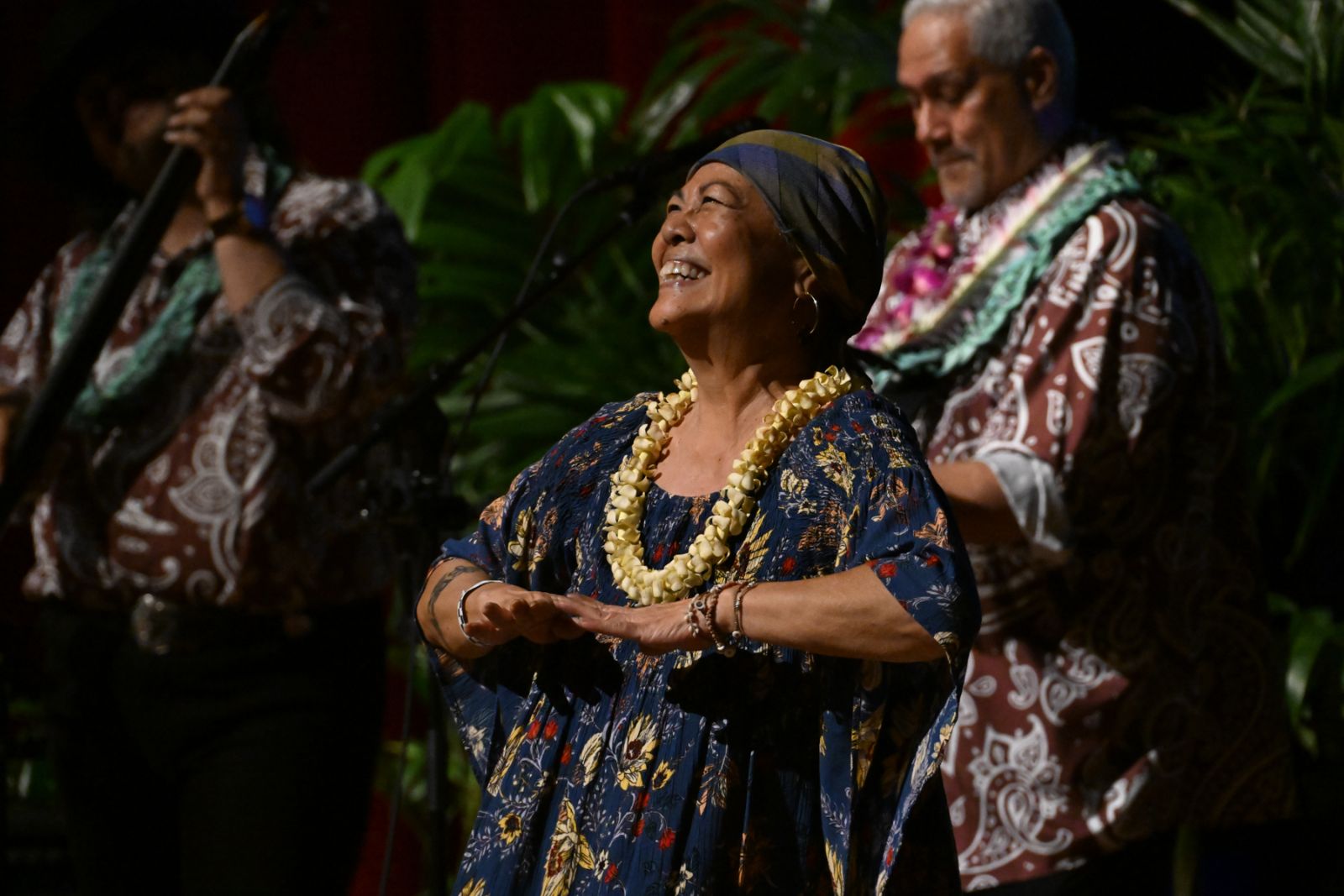
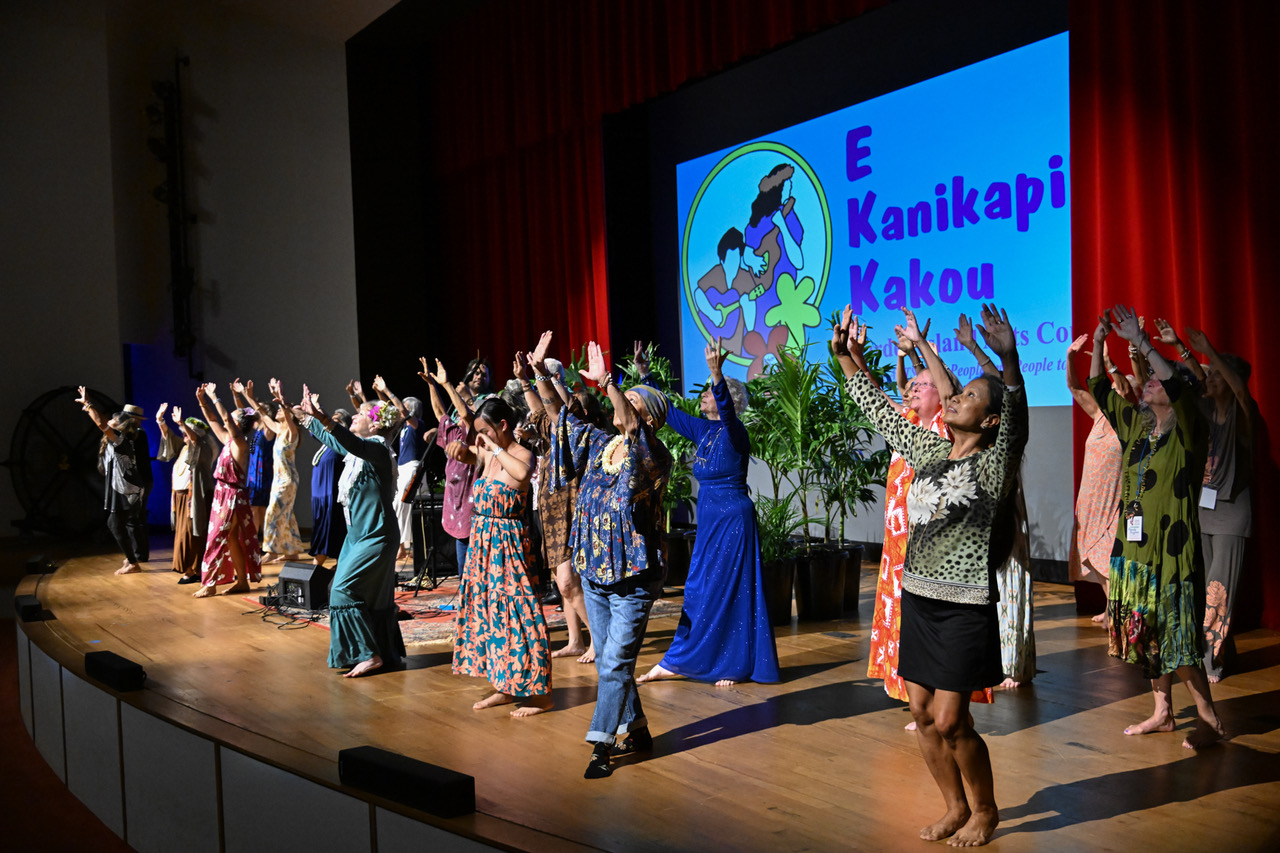
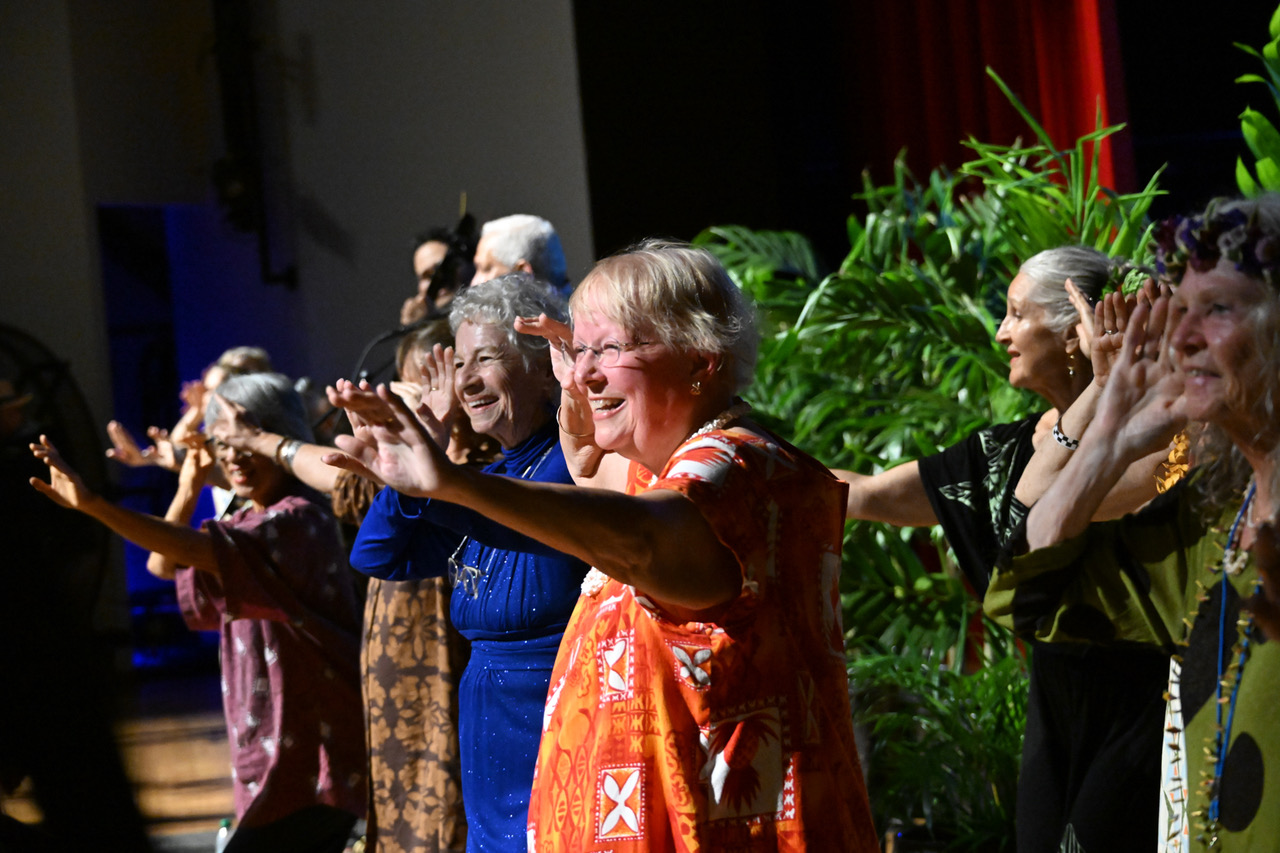
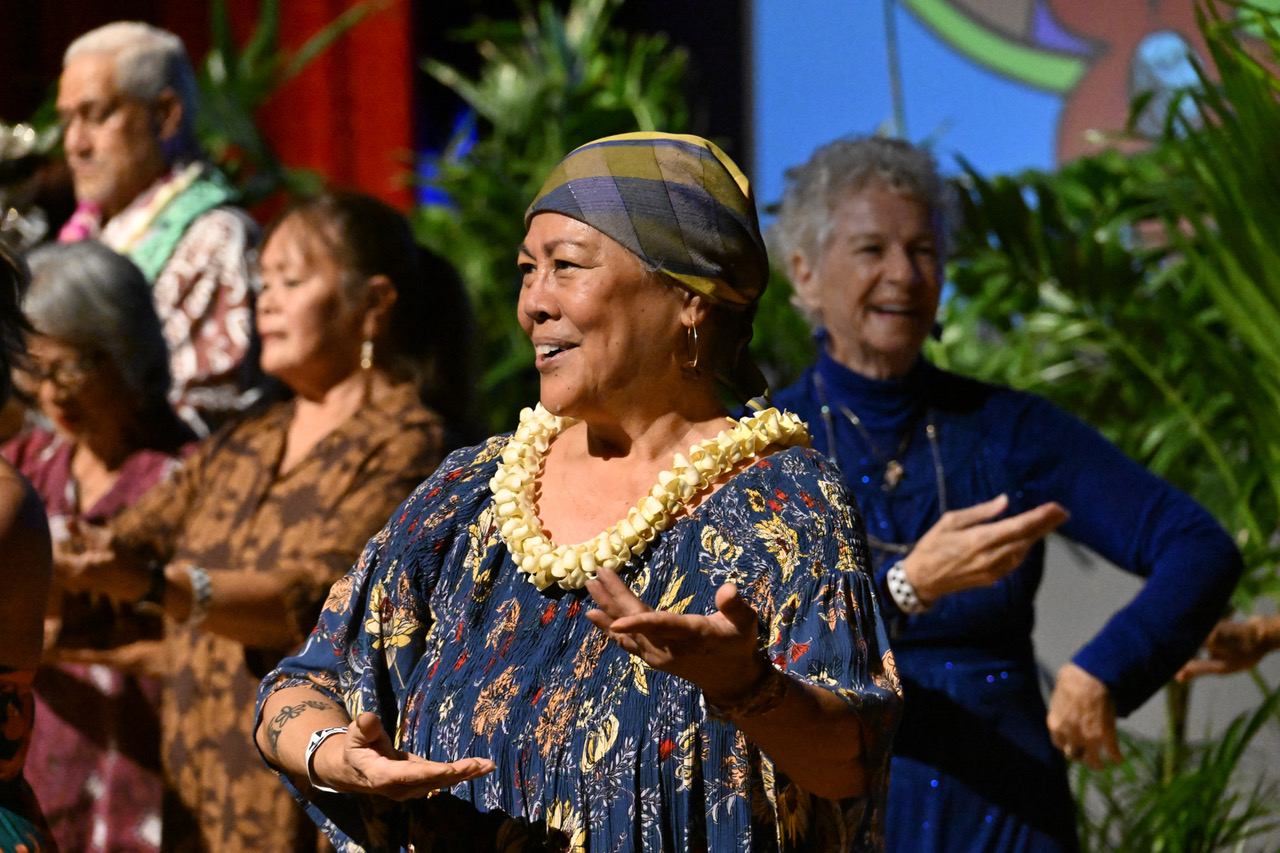
, one of the first songs she was told to sing, is still one of her favorites. She invited the dancers in the audience, “You must come up to dance!” — over 20 dancers rushed up on stage. This is not an opportunity to pass up.
Hula Baby!
is a unique story to share as it does not happen to just anyone. At the end of the year, December 2008, the NFL approached her on the phone with a proposal, asking if she wants to be the first local artist to sing a kick-off song for the Pro Bowl. Is it in English? Yes! Is it about something Hawaiian.Yes! She was asked if she had a song that was 2 minutes and 27 seconds long? Answer was “yes”. Was she prepared to sing it with 100 ʻukulele players plus 300 hula dancers? Of course, the answer was “Yes!”
Please send over a track so the hula dancers and ʻukulele players could learn it. “Uh . . . oh!!!” As the deadline approached, she was suffering a blank mind and dire desperation set in, and just as the meeting was supposed to start, she prayed, “Lord, I need a song!” She prayed one more time. As Natalie relays the story, Iolaniʻs accompaniment on the guitar emphasized the suspense, the tension, and “Lord, sorry for lying about the song . . .” and finally . . . BOOM!” . . . the moment of truth . . . as she burst out with her jazzy up-tempo song -- Hula Baby!
--- she growled out her hula number with all the aplomb she is known for. She had us living through her ordeal, her apprehension, her frustration, and finally . . . the revelation. What a story! What a song! It was sassy! It was sexy! It was in English and about things Hawaiian! It was da bomb! It might have been two minutes and 27 seconds long; the applause was longer than that!
Natalie expressed her appreciation to be asked back to EKK after three years. “There is no word for your program!” On Kauaʻi, we need to do a Kauaʻi song -- Hanalei Moon
is easily the most popular Kauaʻi hula song where hula dancers will race to the stage to share their moves. Although Natalie has never seen the moon in Hanalei in all her visits to Kauaʻi, she feels that she knows what the moon is like from the hula dancers and their choreography.
Natalie sang the first verse; Iolani sang the second verse with Natalie echoing his singing; the song was as mesmerizing as all the dancers in motion.
Both Natalie and Iolani were raised by kumu hula parents. Iolaniʻs mom is Hoakalei Kamauʻu, one of the premier masters of classic dances and chants and a renowned leader in perpetuating authentic traditional Hawaiian songs and dances, largely influenced by her aunt, the legendary Iolani Luahine; Natalieʻs mom and dad, Nā Kumu Hula Howard and Olana Ai trained scores of dancers through their renowned Hālau Hula Olana. Because of their upbringing in hula circles, they learned first to dance and then had to sing when the hālau needed singers. The hālau did not have to look far; the singers were in their backyard. The hālau practices were their training grounds as singers.
Nohili E
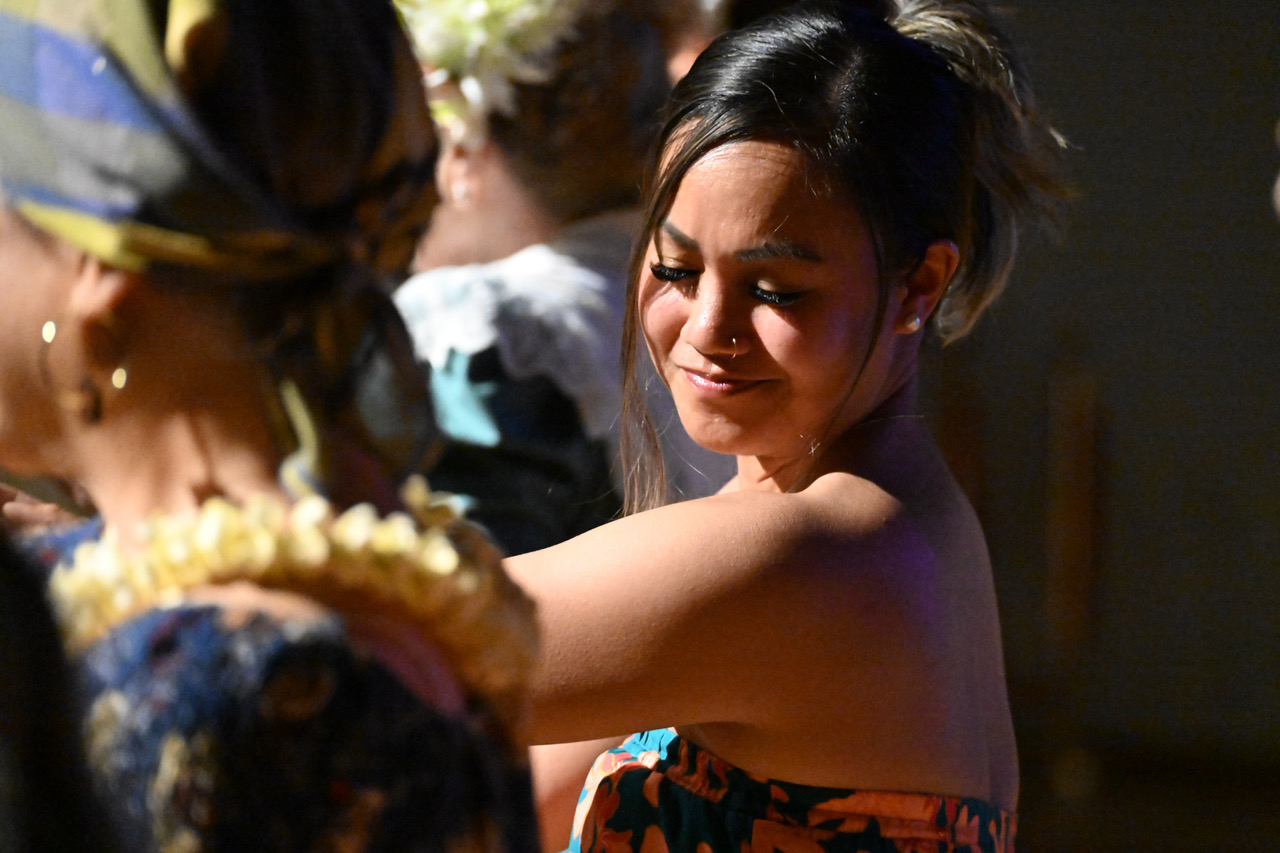
by Muriel Amalu is one of the most beautiful songs about Kauaʻi about a special place with the iconic barking sands of Polihale. Sung in a lower octave than normally sung, the two powerhouse voices of Iolani and Natalie in a duet, really stops you in your tracks. Their combined harmony is exquisite and riveting . . . it makes you hold your breath. Pō’ai and Sabra, sisters in the same hālau, danced together with synchronized choreography. Stunning.
Sabra shared that today they did an excursion to Nohili along with the Hawaiian studies Kūpuna and the Native Plant Society. How serendipitous is that? When they went 30 years ago with Margaret Aipoalani and Lauae Arashiro of Kekaha, they hiked up the sand dunes. Because of the hot, hot sun on the dry sand, every step resulted in a sharp “barking” sound, hence, the barking sands of Nohili. But today, because of so much new native plants growing there, there is moisture in the ground so the sands are not so hot and dry.
Natalieʻs favorite Kauaʻi song is Lizzie Alohikeaʻs Nani Kauaʻi.
Because it’s also a favorite of many artists, we have heard this song performed often . . . but never quite like this. Here is her story about this song.
As a young couple with young children to raise -- Chaz was born in 1992 followed by his sister. With limited means, they spent their early childbearing years without a lot of luxuries, among them travel, and never went on a family vacation. When they finally traveled, they chose to visit Rome where they were introduced to the amazing history, architecture and art of the country with things that were centuries old. Impressive!
But when they returned to the islands where the known history through chants and artifacts number a few hundreds of years old, nowhere near the BC years in Rome, they found little comparison about the unbelievable beauty of this place called Hawaiʻi. Her appreciation of the gorgeous technicolor rainbows and the incomparable scenes all around her, she could no longer compare Hawaiʻi to anywhere else in the world. For her, there is no comparison.
On Kauaʻi . . . the canyons of Kōkeʻe, the stunning beaches, the Waiʻaleʻale mountains were incomparable in their majesty. As she spoke with so much genuine passion in her voice, it must have struck a chord with many in the audience . . . are we really looking all around us and appreciating this place we call home?
She started singing Lizzie Alohikeaʻs Nani Kauaʻi
with so much passion and unbridled feeling that it made you hang on to every syllable as she belted out this familiar, and yet new, song; we never quite heard it sung like that. What an eye-opener!
Even the hula dancers who love this dance could feel that her vocal rendition was something very special . . . it embodied her sincere appreciation of all that surrounds us in our daily lives. It was a moment frozen in time.
Edith Kanakaʻoleʻs Ka Uluwehi O Ke Kai
sung by Iolani and Natalie brought up a slightly different group of dancers – a feisty bunch that liked feisty hula -- Blaine Sasaki, Warren Sparks and Erin Carrington, Queenie Daligdig, Holly Nāmaka Lindsey, Elena Gillespie and Andy Hamano -- showed off every style of picking limu and other seaweed out of the ocean; it appears to be a very active form of exercise with the added treat of delicious seaweed to eat at the end. The audience, too, ate it up and screamed for a hana hou hula.
Natalie and Iolani came up right away with another feisty hula -- Pāpālina Lahilahi
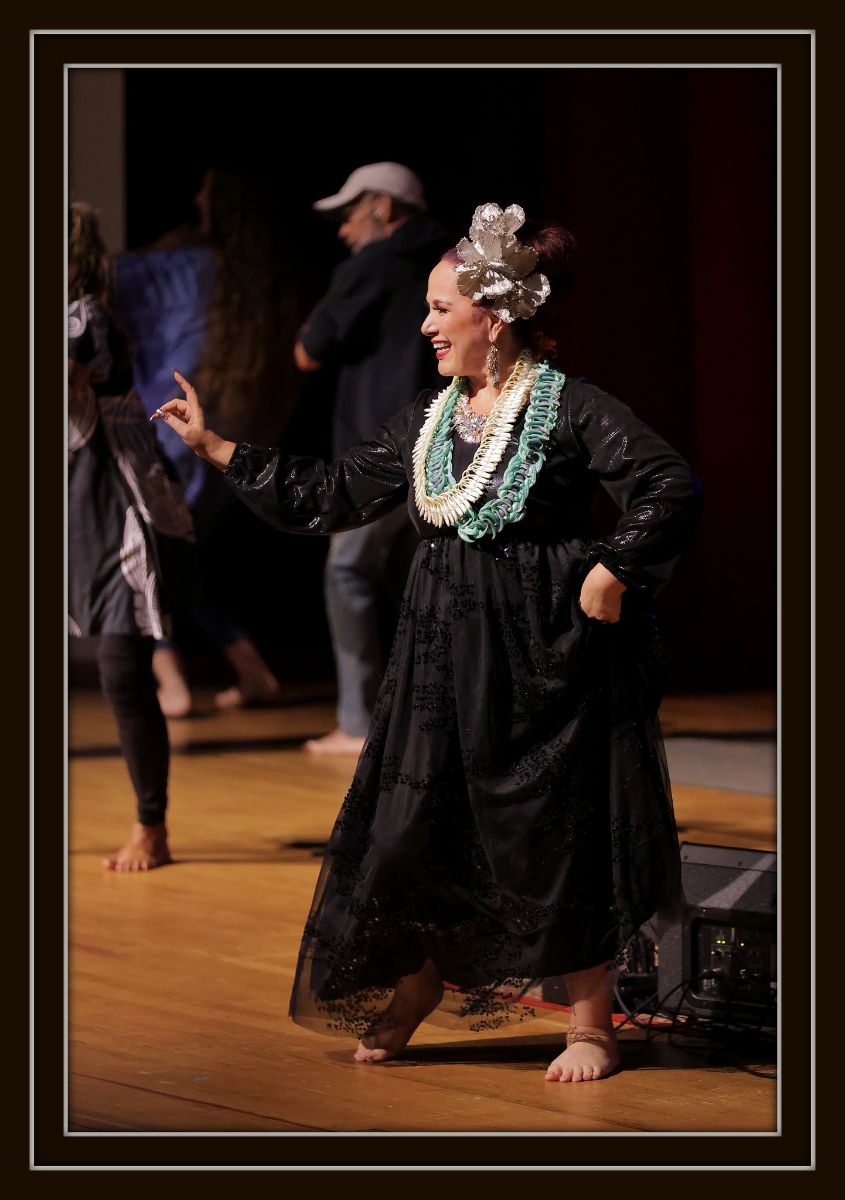
-- a traditional favorite about rosy cheeks. Pōʻai Galindo, Queenie Daligdig, Andy Hamano, Warren Sparks and Erin Carrington were joined by Natalie for another very active number. Watching the dancers, Natalie was moved to join the dancing. Of course, it left her breathless.
“I started the program with an English song; it always makes me think of a Hawaiian song to sing with it.” The next is an English song sung by a Hawaiian named Bruno Mars -- Just The Way You Are.
“When I sing this English song, the song that goes perfectly with this song is the Hawaiian song Uhiwai
which is about a thick mist that rolls through Waimea. This mist makes you feel completely comfortable.” It also makes her think of her grandmother whose name is Uhiwai. When she sings this song, it makes her think about how much she loves her grandmother and her perfectness.
Two ʻukulele were demonstrated by Natalie and Iolani; a beautiful koa ʻukulele made by Tomas Braverman was demonstrated by Natalie and the Kamoa ʻukulele was demonstrated by her husband.
INTERMISSION
Each week a Kamoa Ukulele is given away to one lucky winner from the donor pool; this week the winner was “tan-ta-ra-ra- ran . . . Eric Lazar!!! When his name was announced, there was a long pause until he got word of his big win . . . while we waited, I shared with the audience that Eric got hooked on the ʻukulele at EKK, and after that, he was enrolled in every single ʻukulele circle on island – Kalāheo, Līhuʻe, Kapaʻa, North Shore -- and attended all the ʻukulele jams around the island. He had been trying for years to win the Kamoa ʻukelele. Tonight was the night!
Suddenly, he burst on stage from the apron . . . moving at top speed on his trusty wheelchair to get to center stage . . . he happily received his prize, twirled around and zoomed off the stage to the huge applause of the audience. What a guy! Unstoppable!
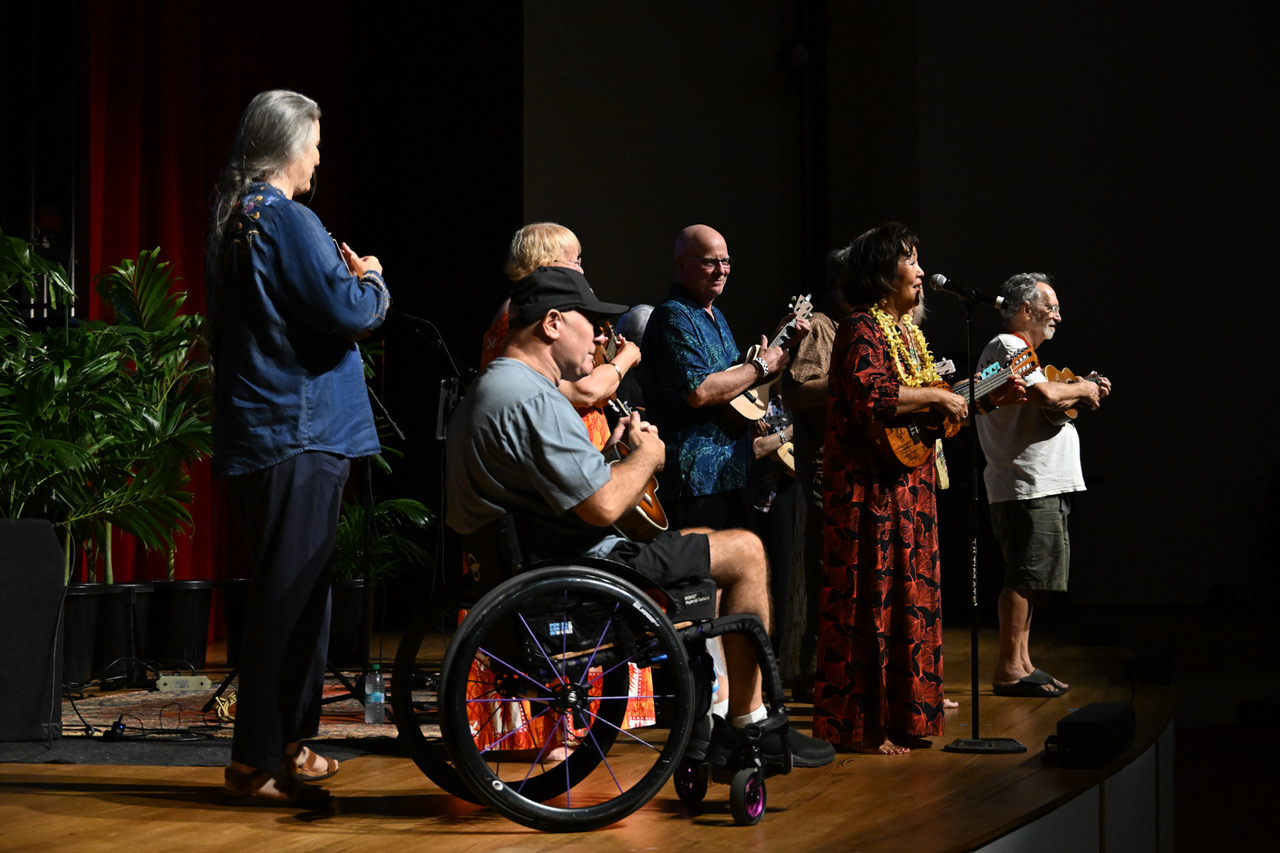
Opening the second half of the program was a quick “mini concert” by the ʻukulele circle led by the fashionable Queenie Daligdig. They performed the hilarious song – Chicken Delight
– which won “Peopleʻs Choice” in the 2025 Mokihana Festival Composers’ Contest and Concert. Queenie composed this delightful song about Kauaʻiʻs infamous chicken population after a community gathering where all the talk was about the many ways to cook chicken. Itʻs all there in the song – the early morning wake-up call and every favorite local chicken dish we enjoy. Everyone in the audience could relate! She asked the audience to join in the song by clapping to the tune of the Chicken Dance
song . . . which surprisingly, everyone knew!
Keeping to the same format of welcoming hula dancers to the stage and grateful for the beauty that surrounds us, Natalie sang “ Aloha Hawaiʻi Kuʻu One Hānau
”. Ten dancers, all with the same choreography, danced this beautiful hula; this means that they all come from the same hula hālau; each hālau interprets songs with very different moves that describe the lyrics as well as the hidden manaʻo of the song.
Lei Nani
by Charles Namahoe is a lei song about but not necessarily a lei of flowers. For this song Madeleine Guyett went up to dance a solo; she was soon joined by Donna Stewart, another one of our resident hula dancers.
Natalie shared the story of when she and Iolani got married. They started talking stories in January, Iolani asked her to marry him in March, and they got married in September. Iolani reminded her over his mic “. . . itʻs 35 years ago tomorrow . . .” that he asked her to marry him. How precious is that! A husband who remembers the important dates! Audience was really impressed with that unexpected announcement!
Natalie described their early living quarters as a young couple with their 30-year-old mustard colored couch, a mattress on the bedroom floor and a beautiful baby crib for Chaz, and a small black and white TV that caught only three channels. Their simple diet of instant saimin and “Hawaiian pancakes” (basically just flour, sugar and water fried on a griddle) and their favorite meal was rice and ketchup (because shoyu was too expensive). Even though their pantry was usually empty and their freezer filled with only ice, their life together was filled with so much love, and they were completely happy and never felt poor. Together they learned what love is in that tiny apartment.
The next song, No Kuʻu Ipo I Ka Ua Noe
captured the sentiment of those early precious years when they started out their love-filled marriage. Iolani sang verse one; Natalie sang verse two; it was a true duet where their voices blended like the love they have for each other. Natalie gave Iolani a big hug and the audience was loving it. Shouts of appreciation rang out throughout the theater.
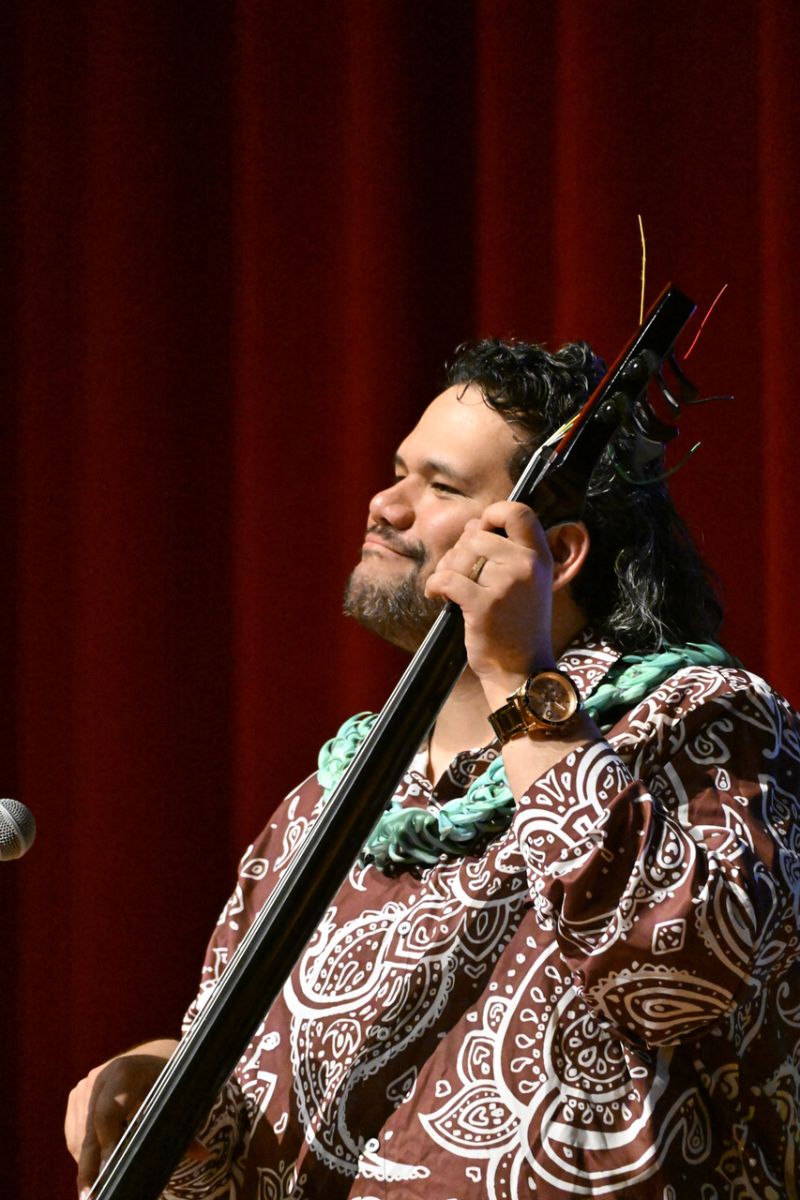
Chaz, our bass player with the cowboy hat, was their first born. Natalieʻs first song was written for Chazʻs younger sister Shelsea; the second song was written for husband Iolani. Finally, Natalie was wanting to write a song for Chazʻs high school graduation.
She asked him what his favorite flower was and the quick reply was “Shower Tree”. Because Chaz is color blind, he can’t see red and green colors, but he can see yellow . . . shower trees have gorgeous yellow blooms. Natalie tried very hard to write a song about shower trees, but it just did not happen. Finally, she compared him to the delicate pakalana blossom, her favorite flower. Chaz liked Pua Pakalana
when he heard it on the radio, “Thatʻs my song!”
Because hula is a natural thing in their family, Chaz grew up as a hula dancer and while he was still very little, he earned the coveted title of “Master Keiki Hula” in the annual Keiki Hula Competition. Heʻs come a long way since the days of Keiki hula as he has really grown up into a strapping young man. But he still dances. They now live in Waimea on Hawaiʻi Island; that part of the island is cowboy country.
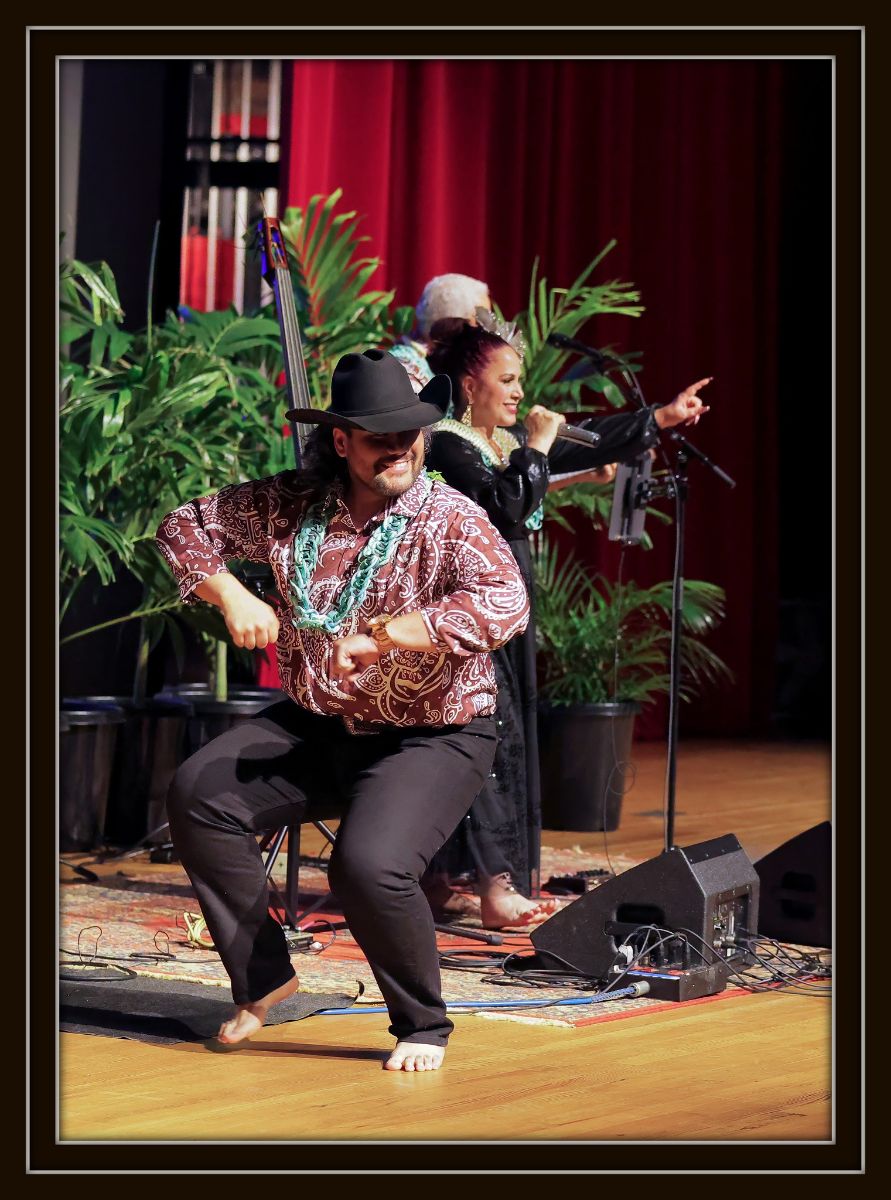
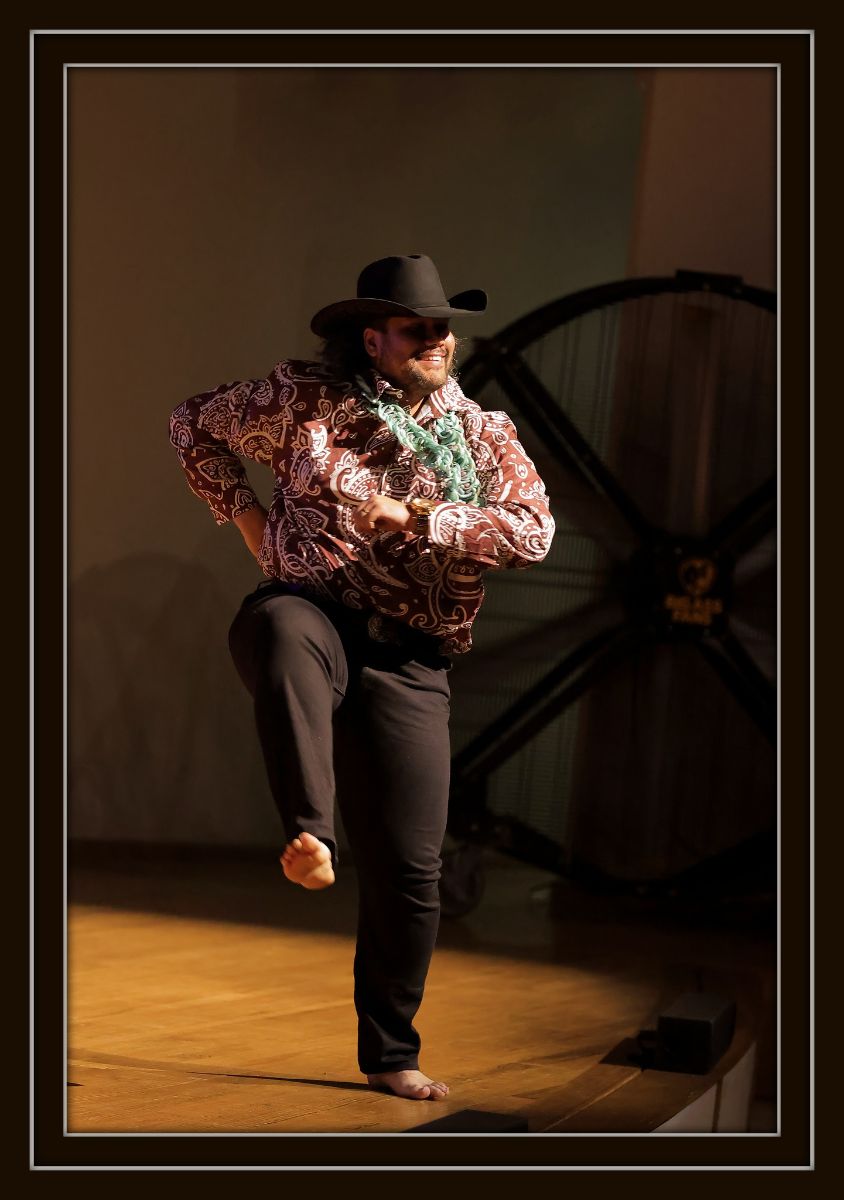
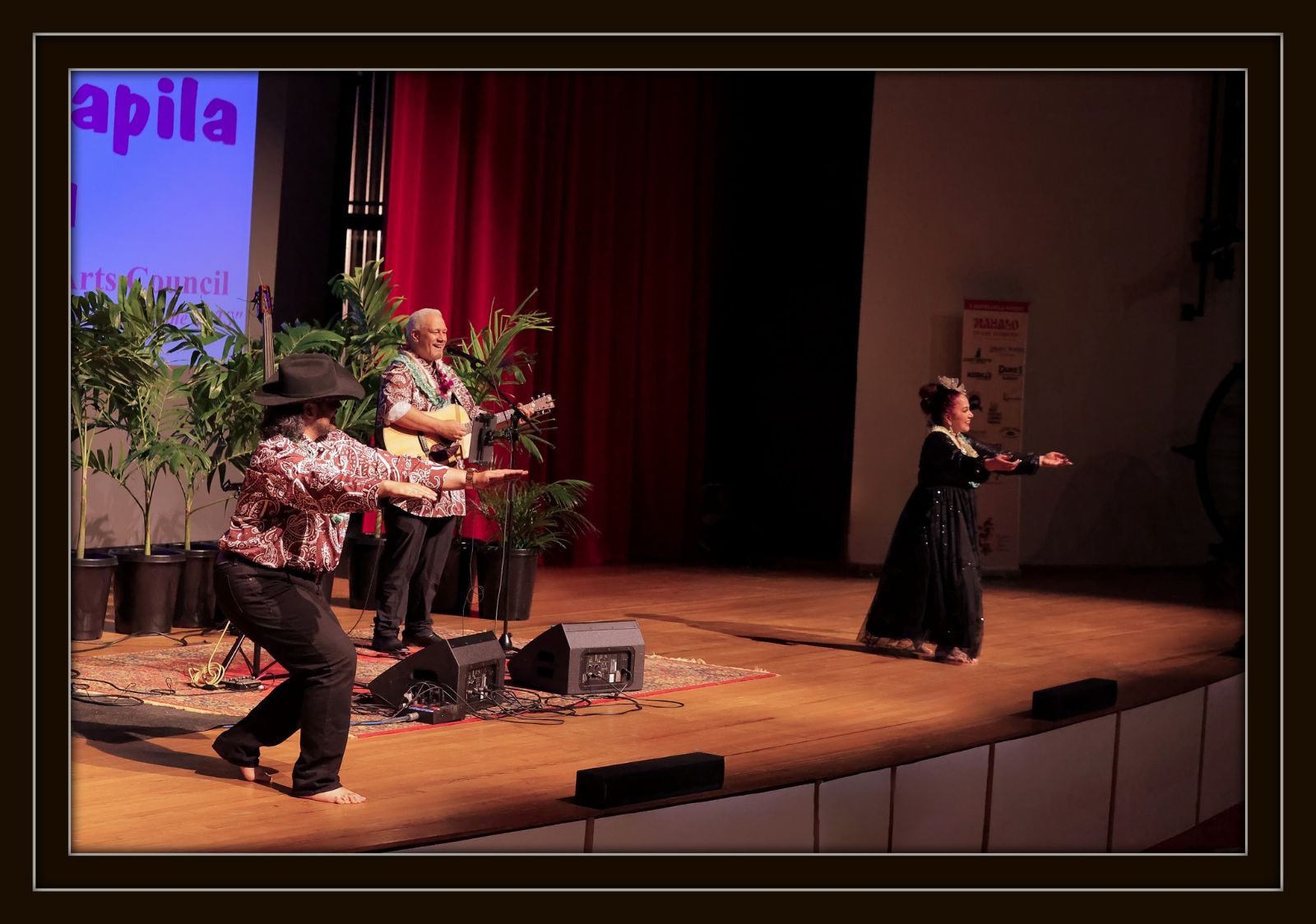
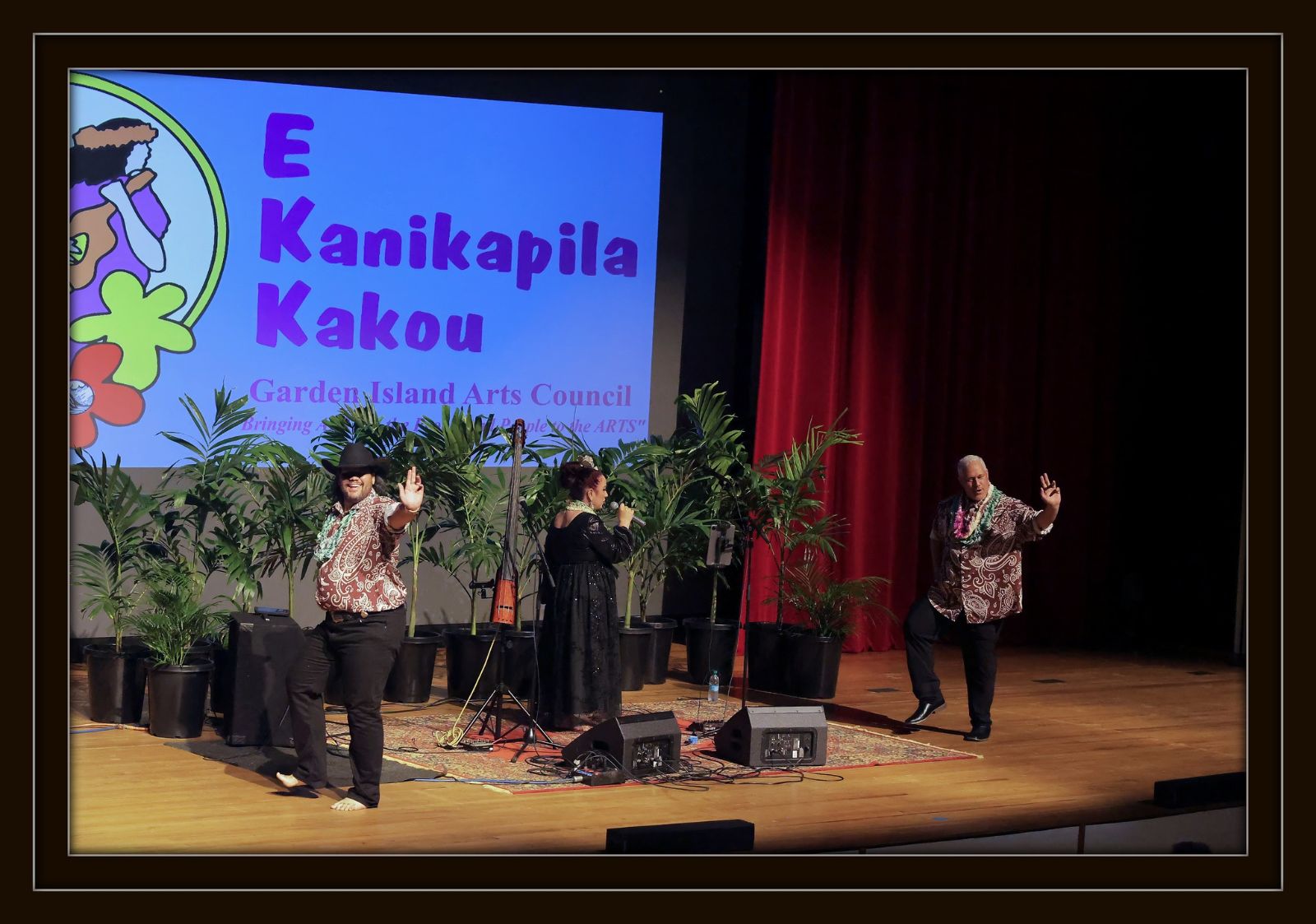
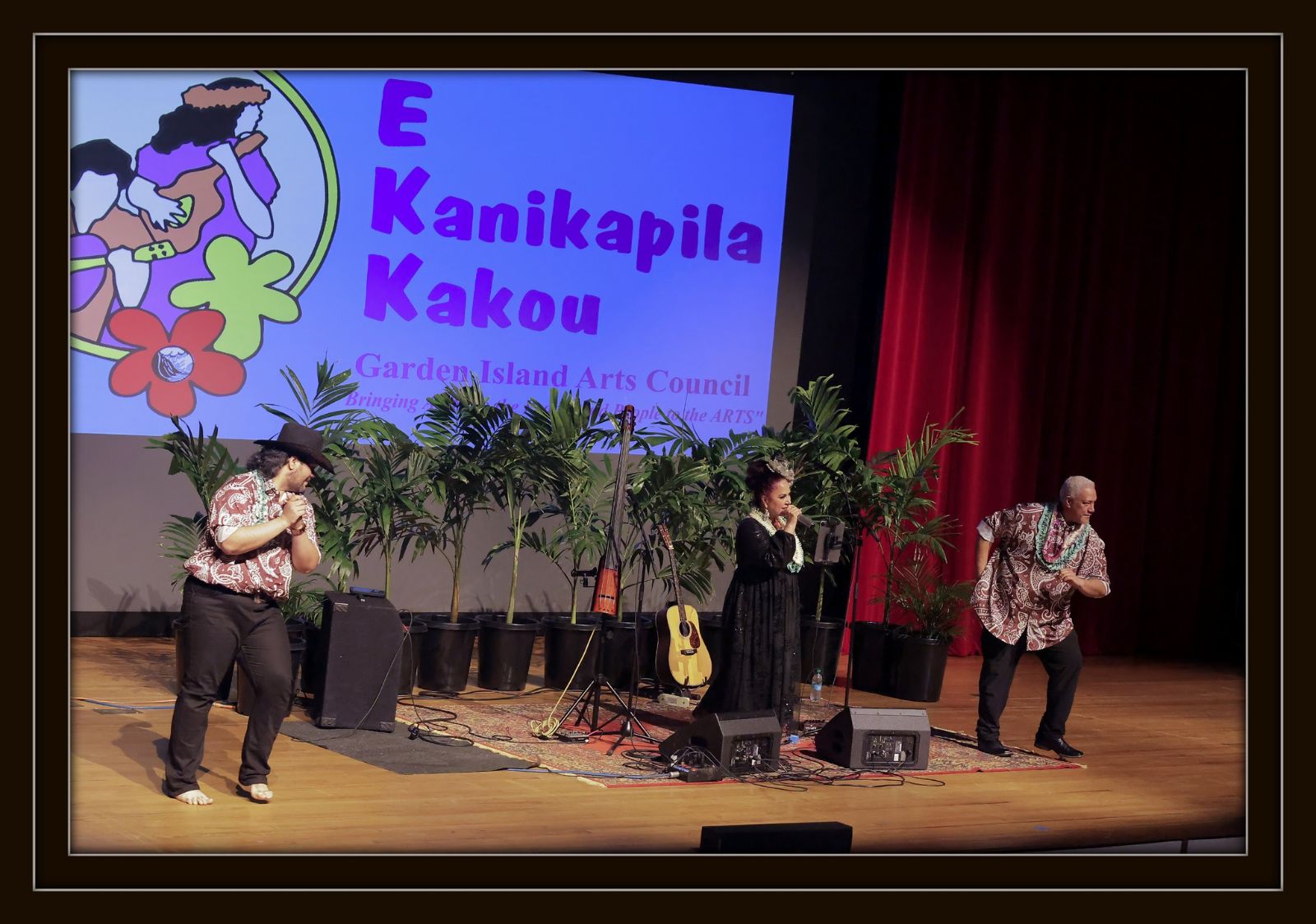
Natalie and Iolani sang a duet so Chaz could dance his rousing ass-slapping hula titled Cowboy Hula. The audience exploded into applause like I never heard before. I was sitting in the front row and the applause spilled over me like an avalanche…and they would not quit. More! More! More by Chaz . . .! the audience just could not settle down after that. “Heʻs got a lot more to move now,” says Natalie.
Chaz owns a hat-wear company called “Uihā Hat Bar”; heʻs wearing one of his hats. On April 3rd Chaz will be doing his entrepreneurial thing in a pop-up event at the Kukui Grove Shopping Center. Iolani puts in a big plug for Chaz. “The exact way he dances is the exact way that he will design your hat.”
Hula lineage was passed down from great grandmother to grandmother, from grandmother to mother, from mother to daughter and this is the way it was. Natalie shared that her dad, Howard Ai, taught Chaz to dance. Not only is her dad a great singer, but he is also a serious kumu hula along with his wife Olana. They have devoted their lives to training young dancers into masterful entertainers who could adapt their hula movements to fit the logistics of any venue even if they had never danced there before. Their dancers are truly exceptional.
Natalieʻs grandmother danced the next song at every party -- E Huli Mākou
by David Chung. Natalie joined Chaz in this fast-moving hula. How they can speak after moving all over the place is really beyond comprehension. Takes a lot of stamina! But I guess if it’s in your DNA, it’s just what you do.
Natalie lifted her full skirt to show her left knee strapped in a knee brace. She was doing a hula workshop in Japan – the room was 85 degrees hot but the floor was ice cold because it was snowing.
An EKK past history story to share here: When I asked Natalie if she would bring her dad to perform with her, she happily agreed. When she arrived on Kauaʻi, her voice had completely shut down to a whisper. Howard Ai ended up carrying all the vocals for that performance and Natalie ended up as the hula dancer. The show must go on!
After having lived in Ewa Beach for 21 years, they finally were able to get their own place on Hawaiian homelands in Waimea, Hawaiʻi. In 2018 Iolani was given Hawaiian Homelands by his cousin. They moved, not knowing how they would build a house with the high cost of construction, but they had faith and took the plunge. She had always wanted to live there because her father was born in Waimea and the rest of the Lindsey family live there. With limited resources, building a home on their new land was a major challenge, but finally one day she found herself standing on the cement foundation of this soon to be home, and she was moved to sing a lullaby. She was acknowledging the love of her ancestors in her song. Waimea Lullaby
by Patrick Downes is in English and she sang it to a soundtrack carrying the melody.
You can really believe you are in cowboy country when your ancestor, Chazʻs great great grandfather, is named Albert “Uihā” Lindsey. She described their life in cowboy country -- cold and rainy all the time with cows and bulls in the back yard. She wanted to share the effect it had on her family . . . in the way they dance and the songs they sing.
Chaz and Iolani stepped to the front and danced Uihā Whoa
(cowboy hula) and ending with “country road take me home.” Natalie would really fit in anywhere in Nashville with that cowboy snarl in her voice. It was really a fun Hawaiian paniolo song and the audience just could not settle down after that.
Their new home is on Kipuʻupuʻu Street right above the famous Waipiʻo Valley where the Uhiwai mist comes right into their bedroom through the windows. Itʻs a very different lifestyle from living in the city and they are loving it. To acknowledge their new digs and new lifestyle, they sang Waimea I Ka Laʻi.
All too soon, the concert was nearly over. On their feet and applauding loudly, the audience would not give up on the hana hou. It turned out to be an incredibly touching show of affection for the fans that she loved so much. Singing the song which was a medley of Whitney Houstonʻs I Will Always Love You
and Pili Aloha
, she slowly ascended the theater stairs while singing, she personally greeted each person all the way to the top of the auditorium and slowly descended back to the stage where she sat down next to none other than Kamahaʻo Haumea-Thronas and his mom while still singing, ending with Whitneyʻs iconic love song. Such was her heartfelt show of affection for her audience. And the beautiful thing is that it was not lost as many streamed down to the front with tears in their eyes, so happy that they were here to witness and be part of this very special night at EKK.
While everyone was on their feet, Iolani and Chaz moved seamlessly into leading the audience into Lorenzo Lyonʻs Hawaiʻi Aloha
, the song that they love to sing at the end of each concert.
Photos by Mike Teruya and Kathleen Ho
Words by Carol Kouchi Yotsuda
COMING UP...
TICKETS ARE SOLD OUT FOR THIS CONCERT!
Monday | March 23rd 2026
Week Eight of
E Kanikapila Kākou
with
Makana
“Lei Kukui”
Summoning his broad influences and kumu lineage, Makana weaves an intimate evening of uplifting and diverse song, stringing together mele and moʻolelo with newly-invented and handed-down slack key tunings, styles and untold stories. Rooted in all things Hawaiian yet ripe with cultural diversity, this rare performance draws from his beloved classics as well as unheard, unreleased repertoire. Join Makana for a night of music to kindle the flames of culture, resilience and a path forward.
Makana has dedicated his life to perpetuating and expanding the realm of Hawaiian slack key guitar. A student of Bobby Moderow Jr. and slack key legends Raymond Kāne and Sonny Chillingworth, Makana’s virtuosic slack key guitar playing and instantly recognizable voice stand at the intersection of folk tradition and cultural avant-gardism. His songs have been featured on multiple Grammy-nominated records, his music is ubiquitous on social platforms (over 1 billion impressions) and his dedication to communities throughout Hawaiʻi has touched countless lives. The NY Times calls him “dazzling” and Esquire magazine has referred to Makana as “one of the greatest living players” of Hawaiian slack key guitar. His music transcends category and trend, and his onstage musical presence is- although purely acoustic- nothing short of symphonic.
Food Concessions by Collab Cafe
TICKETS ARE SOLD OUT FOR THIS CONCERT!
6:00–8:30 PM( Doors open at 5:00; there will be no ‘Ukulele Circle)
Kauaʻi Community College Performing Arts Center
((Traffic advisory:: Pau hana traffic may be heavy for southbound drivers. For a quicker way in, guests may use the Kilohana–KCC access road. Kindly note this access is for arrival only, as the gate closes at 6:30 pm.))

.jpg)
.jpg)
.jpg)
.jpeg)
.png)
.png)
)%20(1080%20x%20800%20px).png)
.png)